
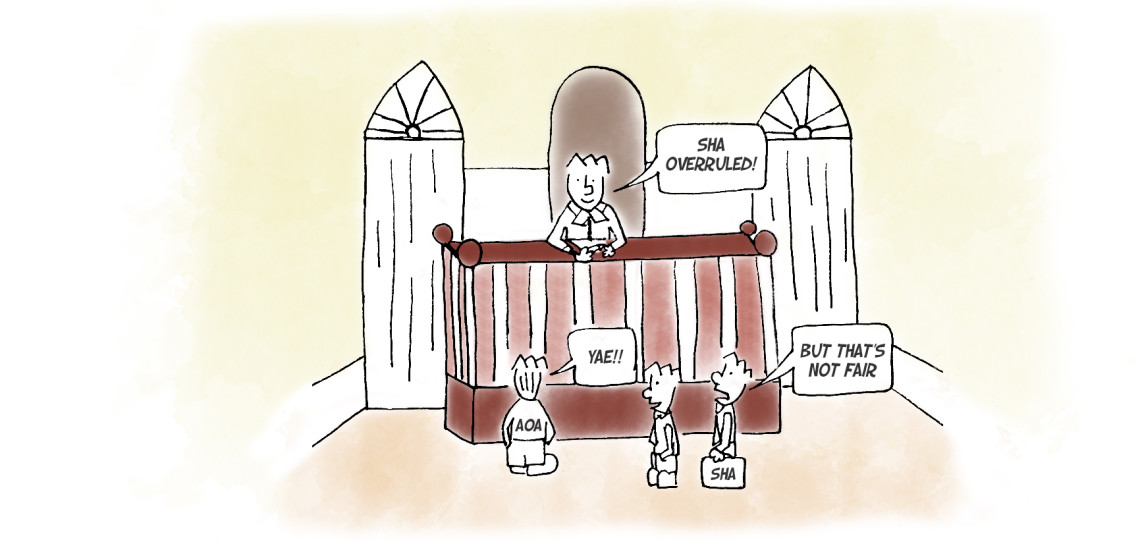
Shareholders Agreement Versus Articles of Association
A Shareholders’ agreement (SHA) is an agreement between shareholders of the company. The main object of entering in to an SHA is to govern shareholders’ investment and lay down clear guidelines on the management of day to day affairs of the company. Typically, an SHA will contain provisions on:
- shareholders’ rights and obligations;
- management of day to day affairs of the company including but not limited to appointment or nomination of director;
- all aspects relating to shares including but not limited to further issue of shares, sale or transfer of shares, restrictions on sale or transfer a;
- protection of minority shareholders of the company and related issues
The Articles of Association (AOA) of a company is a document (which along with the Memorandum of Association) forms the constitution of the company. It expressly lays down provisions relating to the internal management and day to day affairs of the company. Primarily, it defines the responsibilities of the directors, share transfers and means by which shareholders exert control over the Board. Being the mother document, it is a binding contract on all present and future members of the company.
The SHA and AOA contain overlapping and conflicting provisions giving rise to ambiguity over the issue of enforceability of one over the other. This has given rise to the question of whether the clauses in the SHA must be included in the AOA in order to avoid conflict between the two.
Courts’ views
In the case of VB Rangaraj vs. VB Gopalakrishnan 1 the question related to whether the shareholders could enter into an agreement among themselves which is contrary to or inconsistent with the Articles of Association of the company. The Supreme Court took the view that the provisions of a SHA imposing restrictions on transfer of shares even if found to be in accordance with provisions of the Companies Act, are enforceable only when they are incorporated in the Articles of Association of the Company.
On similar lines, in the case of IL& FS Trust Co. Ltd. v. Birla Perucchini Ltd 2 it was held that the decision in VB Rangaraj case would be applicable with respect to conflicts between SHA and AOA and not only to conflicts relating to share transfers. In case of contradiction between the SHA and the Articles of the Company, the latter (i.e. AOA) will prevail.
In World Phone India Pvt. Ltd v. WPI Group Inc USA 3 one of the questions that was considered by the (erstwhile) CLB was whether clauses incorporated in agreements like the SHA / JVA could ipso facto 4 bind the company when there was no corresponding amendment to the articles of association (‘AOA’) of the company. The CLB took a view that section 9 of the Companies Act, 1956 expressly stated that the Act had an overriding effect on the Memorandum and Articles of Association of the company and on any agreement executed by it or resolution passed by the company in its Board or general meeting. It further held that section 9 makes no distinction between private and public company and also between agreements entered by company itself or by directors and shareholders. All that section 9 states is that clauses in the agreement that are ‘repugnant’ to the Act shall be ‘void’. This did not mean that clauses in the agreement which are not repugnant to the Act would be enforceable, notwithstanding that they are not incorporated in the AOA.
However the Supreme Court’s interpretation in Vodafone International Holdings BV v. Union of India 5 was in sharp contrast to the decision by Delhi HC in the VB Rangaraj case. The SC held that shareholders could enter into any arrangement in the best interests of the Company, as long the provisions of SHA were no contrary to the articles of the Company. Further it held that in the event of breach of terms of SHA (which were not breach of terms of AOA), the aggrieved shareholder could pursue legal action as per the law of the land.
Conclusion
The above judicial precedents make it very clear that the stand taken by Courts have been dynamic. The Courts have not adopted a blanket approach in deciding that any provision in SHA which have not been incorporated in the AOA will be invalid. In certain instances, Courts have ruled that if SHA is consistent with the AOA, then for any breach of terms and conditions of SHA, independent legal recourse could be sought.
Till such time the Courts give a decisive verdict on the same, companies shall exercise abundant caution in ensuring that all clauses in agreements like the SHA shall be included in the AOA to avoid conflict of interest between the two.

 He holds a Bachelor’s and Master’s Degree in Corporate Secretaryship and a Degree in Law. He is a Fellow member of the Institute of Company Secretaries of India and an Associate Member of the Corporate Governance Institute, UK and Ireland. He has also completed a program from ISB on ‘Value Creation through Mergers and Acquisitions.
 Mr P Muthusamy is an Indian Revenue Service (IRS) officer with an outstanding career of 30+ years of experience and expertise in all niche areas of Indirect Taxes covering a wide spectrum including GST, Customs, GATT Valuation, Central Excise and Foreign Trade.
 During his judicial role, he heard and decided a large number of cases, including some of the most sensitive, complicated, and high-stake matters on insolvency and bankruptcy, including many cases on resolution plans, shareholder disputes and Schemes of Amalgamation, De-mergers, restructuring etc.,
 A K Mylsamy is the Founder, Managing Partner and the anchor of the firm. He holds a Degree in law and a Degree in Literature. He is enrolled with the Bar Council of Tamil Nadu.
 Mr. K Rajendran is a former Indian Revenue Service (IRS) officer with a distinguished service of 35 years in the Indirect Taxation Department with rich experience and expertise in the fields of Customs, Central Excise, Service Tax and GST. He possesses Master’s Degree in English literature. Prior to joining the Department, he served for the All India Radio, Coimbatore for a period of about 4 years.
 An MBA from the Indian Institute of Management, Calcutta, and an M.Sc. in Tourism Management from the Scottish Hotel School, UK, Ashok Anantram was one fo the earliest IIM graduates to enter the Indian hospitality industry. He joined India Tourism Development Corporation (ITDC) in 1970 and after a brief stint proceeded to the UK on a scholarship. On his return to India, he joined ITC Hotels Limited in 1975. Over the 30 years in this Organisation, he held senior leadership positions in Sales & Marketing and was its Vice President – Sales & Marketing. He was closely involved in decision making at the corporate level and saw the chain grow from a single hotel in 1975 to a very large multi-brand professional hospitality group.
 Mani holds a Bachelor Degree in Science and P.G. Diploma in Journalism and Public Relations. He has a rich and varied experience of over 4 decades in Banking, Finance, Hospitality and freelance Journalism. He began his career with Andhra Bank and had the benefit of several training programs in Banking.
 Mr. Kailash Chandra Kala joined the Department of Revenue, Ministry of Finance as ‘Customs Appraiser’ at Mumbai in the year 1993.
 S Ramanujam, is a Chartered Accountant with over 40 years of experience and specialization in areas of Corporate Tax, Mergers or Demergers, Restructuring and Acquisitions. He worked as the Executive Vice-President, Group Taxation of the UB Group, Bangalore.
 K K Balu holds a degree in B.A and B.L and is a Corporate Lawyer having over 50 years of Legal, Teaching and Judicial experience.
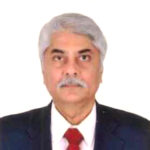 Justice M. Jaichandren hails from an illustrious family of lawyers, academics and politicians. Justice Jaichandren majored in criminology and then qualified as a lawyer by securing a gold medal. He successfully practiced in the Madras High Court and appeared in several civil, criminal, consumer, labour, administrative and debt recovery tribunals. He held office as an Advocate for the Government (Writs Side) in Chennai and was on the panel of several government organizations as senior counsel. His true passion lay in practicing Constitutional laws with focus on writs in the Madras High Court. He was appointed Judge, High Court of Madras in December 2005 and retired in February 2017.
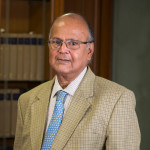 S Balasubramanian is a Commerce and Law Graduate. He is a member of the Delhi Bar Council, an associate Member of the Institute of Chartered Accountants of India, the Institute of Company Secretaries of India and Management Accountants of India.