
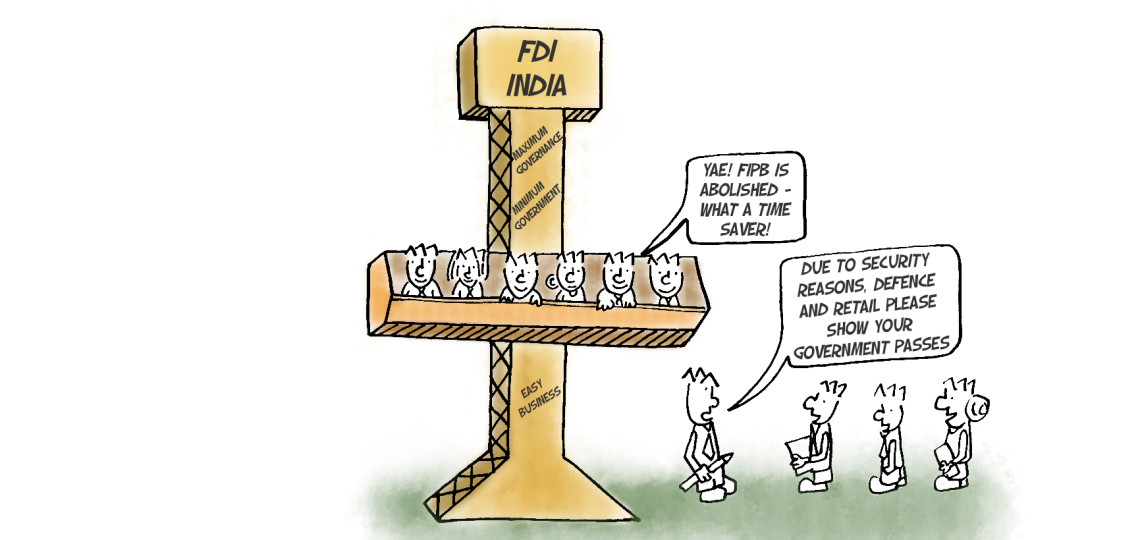
FIPB Abolished- How good is it for FDI?
Foreign Investment Promotion Board is an inter – ministerial body, which was responsible for the procession of the FDI proposals made to the Government of India. The FIPB was under the department of Economic Affairs, Ministry of Finance. It was also governed by the Department of industrial policy and promotion in the Ministry of Commerce and industry, whose policies of FDI, press notes and other related guidelines were the basis of the decisions of FIPB. It was a single window clearance for proposals of Foreign Direct Investments in India. The FIPB is now abolished as announced during the Financial Budget speech 2017-2018 which has led to the closure of the two routes for incoming FDI.
Sectoral Routes
Foreign Direct Investments flows into India in two ways, through automatic route and through Government approval. FIPB deals with the latter, where approvals were obtained. The Finance Minister was in charge of the recommendations from FIPB on foreign equity for up to Rs. 5000 Crores and the recommendations above the said amount would go to the cabinet committee on economic affairs for their consideration. The sectors under the automatic route would not require any approvals from the FIPB and only come under the sectoral laws. More number of sectors were put into the automatic route list giving way for liberalization of FDI.
FIPB Abolishment Liberisation of FDI
Over the years, the FDI norms were liberalised and more so in the last two years, keeping in line with the Make in India program, many sectors were moved to the automatic route and did not require the FIPB approval.in November 2015, 15 sectors were liberalised and in June 2016 many sweeping changes were made in the FDI policies of India. Owing to this drastic change, in the budget 2017-2018, FIPB was totally abolished. The Finance Minister had pointed out that more than 90% of the foreign investments come under the automatic route and presence of FIPB had become redundant which paved way for liberal FDI policies. The liberalisation of FDI has led to increased inflow of investments. Further the Government has taken various steps like relaxation of norms for NRIs, PIOs and OCIs allowing their investments to be treated on par with the domestic investments. The Government has also decided to grant Permanent Residency Status for 10 years to foreign investors who meet a specific set of criteria. All these measures lead to the abolishment of FIPB that has eventually increased FDI inflow, and in turn developing the economy..
Scenario after the Union Budget, 2017-2018
The abolishment of FIPB was called as a welcome move by various economists and investors. Economists claimed that this measure would open up the Indian economy more and attract foreign investors which can act as a major boost to the ‘Make in India’ initiative. As on date, after the abolishment of FIPB, all investments except for the sectors of Retail and Defence come through the automatic route. The Government has also clarified on this, that it would continue with several reforms to strengthen foreign investments. Other foreign investors would go through only the sectoral laws for the investments.
Conclusion
The measures taken by the Indian Government is a clear message to the foreign investors that the Indian economy is open for investments and FDI is beneficial to both India and the investors. The abolishment of FIPB is a one step forward towards easing the FDI norms. India being one of the emerging new economies, it would attract more business which in turn would create more job opportunities to the growing population.







 He holds a Bachelor’s and Master’s Degree in Corporate Secretaryship and a Degree in Law. He is a Fellow member of the Institute of Company Secretaries of India and an Associate Member of the Corporate Governance Institute, UK and Ireland. He has also completed a program from ISB on ‘Value Creation through Mergers and Acquisitions.
 Mr P Muthusamy is an Indian Revenue Service (IRS) officer with an outstanding career of 30+ years of experience and expertise in all niche areas of Indirect Taxes covering a wide spectrum including GST, Customs, GATT Valuation, Central Excise and Foreign Trade.
 During his judicial role, he heard and decided a large number of cases, including some of the most sensitive, complicated, and high-stake matters on insolvency and bankruptcy, including many cases on resolution plans, shareholder disputes and Schemes of Amalgamation, De-mergers, restructuring etc.,
 A K Mylsamy is the Founder, Managing Partner and the anchor of the firm. He holds a Degree in law and a Degree in Literature. He is enrolled with the Bar Council of Tamil Nadu.
 Mr. K Rajendran is a former Indian Revenue Service (IRS) officer with a distinguished service of 35 years in the Indirect Taxation Department with rich experience and expertise in the fields of Customs, Central Excise, Service Tax and GST. He possesses Master’s Degree in English literature. Prior to joining the Department, he served for the All India Radio, Coimbatore for a period of about 4 years.
 An MBA from the Indian Institute of Management, Calcutta, and an M.Sc. in Tourism Management from the Scottish Hotel School, UK, Ashok Anantram was one fo the earliest IIM graduates to enter the Indian hospitality industry. He joined India Tourism Development Corporation (ITDC) in 1970 and after a brief stint proceeded to the UK on a scholarship. On his return to India, he joined ITC Hotels Limited in 1975. Over the 30 years in this Organisation, he held senior leadership positions in Sales & Marketing and was its Vice President – Sales & Marketing. He was closely involved in decision making at the corporate level and saw the chain grow from a single hotel in 1975 to a very large multi-brand professional hospitality group.
 Mani holds a Bachelor Degree in Science and P.G. Diploma in Journalism and Public Relations. He has a rich and varied experience of over 4 decades in Banking, Finance, Hospitality and freelance Journalism. He began his career with Andhra Bank and had the benefit of several training programs in Banking.
 Mr. Kailash Chandra Kala joined the Department of Revenue, Ministry of Finance as ‘Customs Appraiser’ at Mumbai in the year 1993.
 S Ramanujam, is a Chartered Accountant with over 40 years of experience and specialization in areas of Corporate Tax, Mergers or Demergers, Restructuring and Acquisitions. He worked as the Executive Vice-President, Group Taxation of the UB Group, Bangalore.
 K K Balu holds a degree in B.A and B.L and is a Corporate Lawyer having over 50 years of Legal, Teaching and Judicial experience.
 Justice M. Jaichandren hails from an illustrious family of lawyers, academics and politicians. Justice Jaichandren majored in criminology and then qualified as a lawyer by securing a gold medal. He successfully practiced in the Madras High Court and appeared in several civil, criminal, consumer, labour, administrative and debt recovery tribunals. He held office as an Advocate for the Government (Writs Side) in Chennai and was on the panel of several government organizations as senior counsel. His true passion lay in practicing Constitutional laws with focus on writs in the Madras High Court. He was appointed Judge, High Court of Madras in December 2005 and retired in February 2017.
 S Balasubramanian is a Commerce and Law Graduate. He is a member of the Delhi Bar Council, an associate Member of the Institute of Chartered Accountants of India, the Institute of Company Secretaries of India and Management Accountants of India.