
Related Party Transaction
A Related Party transaction (‘RPT’) is a business deal or arrangement between two parties who are joined by a special relationship prior to the deal. Section 188 (‘Section’) of the Companies Act, 2013 (‘Act’) places more reliance on disclosure with members’ approval rather than on regulatory approvals. The Section requires a company to obtain approval of the Board and of the members, in certain situations, prior to entering of any transaction or agreement with a related party.
I. Applicability of the Section
Section 188 is applicable to both Private and Public companies.
II. Definitions
Related Party
According to Section 2(76) of the Act, Related Party with reference to a company means:
- a Director 1or his relative;
- a Key Managerial Personnel 2 or his relative;
- a firm, in which a Director, Manager or his relative is a partner;
- a Private Company 3 in which a Director or Manager or his relative is a Member or Director;
- a Public Company 4 in which a Director or Manager is a Director and holds along with his relatives, more than two per cent of its paid-up share capital;
- any Body Corporate 5 whose Board of Directors, Managing Director or Manager is accustomed to act in accordance with the advice, directions or instructions of a Director or Manager;
- any person on whose advice, directions or instructions a Director or Manager is accustomed to act, except advice, directions or instructions given in a professional capacity;
- any company which is:
- a Holding, Subsidiary or an Associate company of such company;
- or a Subsidiary of a Holding Company to which it is also a Subsidiary;
- such other person as may be prescribed; 6
Relative
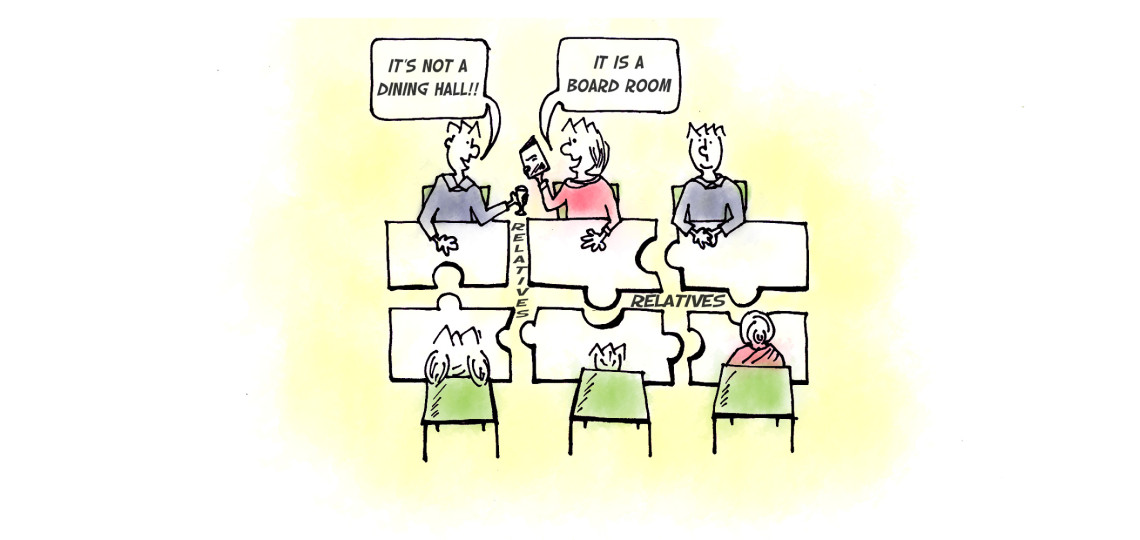
According to Section 2(77) of the Act, Relative means anyone who is related to another, if:
- they are members of a Hindu Undivided Family;
- they are husband and wife; or
- one person is related to the other in such manner as may be prescribed; 7
Rule 4 of Companies (Specification of Definition Details) Rules,2014 read with clause (77) of Section 2 of the Act, states that a person shall be deemed to be the relative of another, if he or she is related to another in the following manner:
- Father includes step-father.
- Mother includes step-mother.
- Son includes step-son.
- Son’s wife.
- Daughter.
- Daughter’s husband.
- Brother includes step-brother
- Sister includes step-sister.
III. Related Party Transactions

IV. Approvals Required
- Board Approval- Rule 15(1) of Companies (Meetings of Board and its Powers) Rules, 2014 states the agenda of the Board meeting where the resolution is proposed to be passed considering the following:
- the name of the related party and nature of relationship;
- the nature, duration of the contract and particulars of the contract or arrangement;
- the material terms of the contract or arrangement including the value, if any;
- any advance paid or received for the contract or arrangement, if any;
- the manner of determining the pricing and other commercial terms, both included as part of contract and not considered as part of the contract;
- whether all factors relevant to the contract have been considered, if not, the details of factors not considered with the rationale for not considering those factors; and
- any other information relevant or important for the Board to take a decision on the proposed transaction.
- Shareholders approval– Rule 15(3) of Companies (Meetings of Board and its Powers) Rules, 2014 states that, except with the prior approval of the company by a resolution a company shall not enter into transaction(s).
S. No |
Transaction |
Prior Approval of Company by Resolution required, if Transaction Value exceeds |
| a) | Sale, purchase or supply of any goods or materials (directly or through appointment of agent) | Least of: 10 % of Turnover (or) Rs. 100 crores |
| b) | Selling or otherwise disposing of, or buying, property of any kind (directly or through appointment of agent) | Least of: 10 % of Net worth (or) Rs. 100 crores |
| c) | Leasing of property of any kind | Least of: 10 % of Turnover (or) 10 % of Net worth (or) Rs. 100 crores |
| d) | Availing or rendering of any services (directly or through appointment of agent) | Least of: 10 % of Turnover (or) Rs. 50 crores |
| e) | Appointment of any agent for purchase or sale of goods, materials, services or property | Appointment of Agents may pertain to RPTs in (a), (b), (d) above. |
| f) | Related party’s appointment to any office or place of profit in the company, its subsidiary company or associate company | Monthly Remuneration > Rs. 2,50,000 |
| g) | Underwriting the subscription of any securities or derivatives thereof, of the company | Remuneration for Underwriting > 1% of Net Worth |
- The requirement of passing the resolution shall not be applicable for transactions entered into between a holding company and its wholly owned subsidiary whose accounts are consolidated with such holding company and placed before the shareholders at the general meeting for approval. 8
- The limits specified in points (a) to (d) shall apply to transaction(s) to be entered into either individually or taken together with the previous transactions during a financial year.
- The turnover or the net worth shall be computed on the basis of Audited Financial Statement of the preceding financial year.
- However, in case of wholly owned subsidiary, the resolution passed by the holding company shall be sufficient for the purpose of entering into the transactions between the wholly owned subsidiary and the holding company.
V. Disclosures in the Explanatory Statement:
- Name of the related party;
- Name of the director or key managerial personnel who is related, if any;
- Nature of relationship;
- Nature, material terms, monetary value and particulars of the contract or arrangement;
- Any other information relevant or important for the members to take a decision on the proposed resolution.
Restrictions on Voting |
Director:Interested Director 9 shall not be present at the meeting during discussions on the subject matter of the resolution relating to such contract or arrangement. 10 |
Member:A member who is a related party shall not vote on such resolution to approve any contract or agreement. 11 |
Transactions in the ‘ordinary course of Business’ and at ‘Arm’s length basis’ are not covered under S.188(1).
VI. Office or place of profit:
Office or place of profit |
Held by Director | Held by an Individual, Firm, Private Company or Body Corporate |
Remuneration |
Remuneration received from the company over and above the remuneration he is entitled as a Director. | Received from the company anything by the way of remuneration, salary, fee, commission, perquisites, rent free accommodation. |
Every contracts or agreements entered shall be referred to the Board’s Report.
VII. Effect of Contravention

VIII. Violation Section 188
Type of company |
Listed company |
Any other company |
| Punishment | Imprisonment which may extend to 1 year or with minimum fine of Rs. 25,000 and maximum fine of Rs.5,00,000 or with both. | Minimum fine of Rs. 25,000 and maximum fine of Rs.5,00,000 |
IX. Non-applicability
In case of a Private Company:
If a member is a Related Party, he shall not vote on such resolution to approve any contract or arrangement.
In case of Government Company:
A Government Company, other than a listed company, in respect of contracts or arrangements other than sale, purchase or supply of any goods or materials, where the company obtains approval of the Ministry or Department of the Central Government or State Government before entering into such contract or arrangement.
X. Related Party Transactions for listed companies: Regulation 23 of SEBI (Listing Obligations and Disclosure Requirements) Regulations 2015 (‘Regulation)
- Where contracts are entered into between two Government Companies.
- This regulation is effective from September 2, 2015 and shall be applicable to all prospective transactions. In case there is any material or substantial changes in terms and conditions of existing RPT that would be governed by the Regulation.
- It is mandatory for the listed company to formulate a policy on materiality of RPTs.
- RPTs shall require prior approval of Audit Committee.
- The Audit Committee may grant omnibus approval for RPTS.
- All Related Party must abstain from voting.
- However as per Section 188 of the Act, only the party to the contract is prohibited from voting.
- Existing RPT transaction must be placed in the first general meeting held after September 2012.
XI. Forms to be filed with the ROC:
S.no |
Forms |
Details |
| 1. | Form AOC 2 |
|
| 2. | Form AOC 3 |
|
| 3. | Form AOC 4 |
|
Notes:
- Section 2(34) of the Act ↩
- Section 2(51) of the Act ↩
- Section 2(68) of the Act ↩
- Section 2(71) of the Act ↩
- Section 2(11) of the Act ↩
- Rule 3 of Companies (Specification of Definition Details) Rules,2014 – A Director other than an Independent Director or Key Managerial Personnel of the Holding Company or his relative with reference to a company, shall be deemed to be a related party. ↩
- Rule 4 of Companies (Specification of Definition Details) Rules,2014 ↩
- Proviso 4 of Section 188 of the Act ↩
- Section 2(49) of the Act ↩
- Rule 15(2) of Companies (Meetings of Board and its Powers) Rules, 2014 ↩
- Proviso 2 of Section 188(1) of the Act ↩
Insider Trading
Rotation of Auditors
related post



Leave a comment
You must be logged in to post a comment.

 He holds a Bachelor’s and Master’s Degree in Corporate Secretaryship and a Degree in Law. He is a Fellow member of the Institute of Company Secretaries of India and an Associate Member of the Corporate Governance Institute, UK and Ireland. He has also completed a program from ISB on ‘Value Creation through Mergers and Acquisitions.
 Mr P Muthusamy is an Indian Revenue Service (IRS) officer with an outstanding career of 30+ years of experience and expertise in all niche areas of Indirect Taxes covering a wide spectrum including GST, Customs, GATT Valuation, Central Excise and Foreign Trade.
 During his judicial role, he heard and decided a large number of cases, including some of the most sensitive, complicated, and high-stake matters on insolvency and bankruptcy, including many cases on resolution plans, shareholder disputes and Schemes of Amalgamation, De-mergers, restructuring etc.,
 A K Mylsamy is the Founder, Managing Partner and the anchor of the firm. He holds a Degree in law and a Degree in Literature. He is enrolled with the Bar Council of Tamil Nadu.
 Mr. K Rajendran is a former Indian Revenue Service (IRS) officer with a distinguished service of 35 years in the Indirect Taxation Department with rich experience and expertise in the fields of Customs, Central Excise, Service Tax and GST. He possesses Master’s Degree in English literature. Prior to joining the Department, he served for the All India Radio, Coimbatore for a period of about 4 years.
 An MBA from the Indian Institute of Management, Calcutta, and an M.Sc. in Tourism Management from the Scottish Hotel School, UK, Ashok Anantram was one fo the earliest IIM graduates to enter the Indian hospitality industry. He joined India Tourism Development Corporation (ITDC) in 1970 and after a brief stint proceeded to the UK on a scholarship. On his return to India, he joined ITC Hotels Limited in 1975. Over the 30 years in this Organisation, he held senior leadership positions in Sales & Marketing and was its Vice President – Sales & Marketing. He was closely involved in decision making at the corporate level and saw the chain grow from a single hotel in 1975 to a very large multi-brand professional hospitality group.
 Mani holds a Bachelor Degree in Science and P.G. Diploma in Journalism and Public Relations. He has a rich and varied experience of over 4 decades in Banking, Finance, Hospitality and freelance Journalism. He began his career with Andhra Bank and had the benefit of several training programs in Banking.
 Mr. Kailash Chandra Kala joined the Department of Revenue, Ministry of Finance as ‘Customs Appraiser’ at Mumbai in the year 1993.
 S Ramanujam, is a Chartered Accountant with over 40 years of experience and specialization in areas of Corporate Tax, Mergers or Demergers, Restructuring and Acquisitions. He worked as the Executive Vice-President, Group Taxation of the UB Group, Bangalore.
 K K Balu holds a degree in B.A and B.L and is a Corporate Lawyer having over 50 years of Legal, Teaching and Judicial experience.
 Justice M. Jaichandren hails from an illustrious family of lawyers, academics and politicians. Justice Jaichandren majored in criminology and then qualified as a lawyer by securing a gold medal. He successfully practiced in the Madras High Court and appeared in several civil, criminal, consumer, labour, administrative and debt recovery tribunals. He held office as an Advocate for the Government (Writs Side) in Chennai and was on the panel of several government organizations as senior counsel. His true passion lay in practicing Constitutional laws with focus on writs in the Madras High Court. He was appointed Judge, High Court of Madras in December 2005 and retired in February 2017.
 S Balasubramanian is a Commerce and Law Graduate. He is a member of the Delhi Bar Council, an associate Member of the Institute of Chartered Accountants of India, the Institute of Company Secretaries of India and Management Accountants of India.