
The Long and Short of the New Merger and Amalgamation Rules
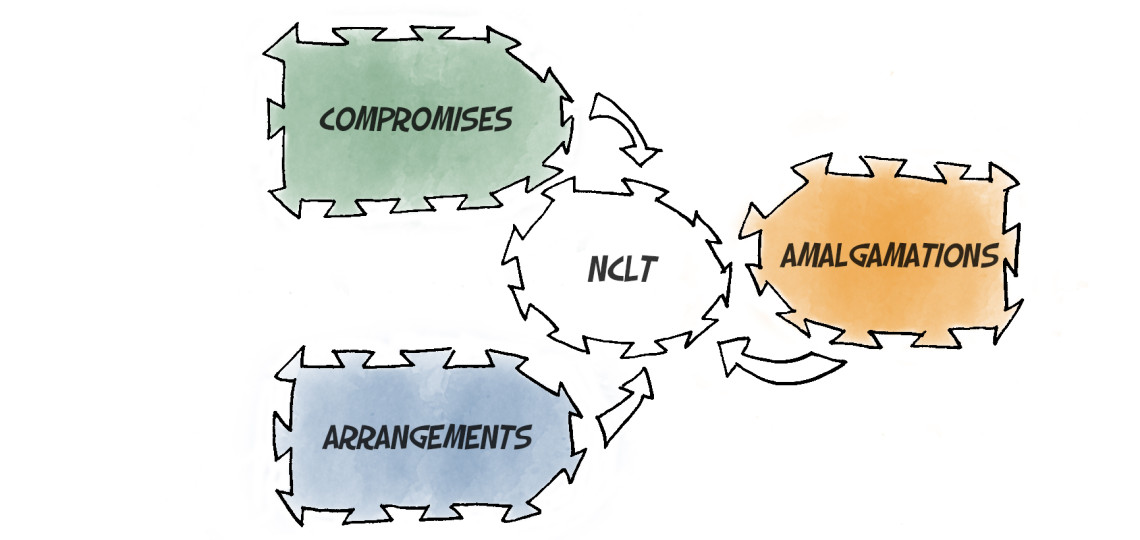
The Ministry of Corporate Affairs (‘MCA’) vide its notification dated 14th Dec, 2016 has issued The Companies (Compromises, Arrangements and Amalgamations) Rules, 2016. The Rules will come into effect from 15th December, 2016. Consequently, w.e.f. 15th December, 2016 all matters relating to Compromises, Arrangements, and Amalgamations will be dealt as per the provisions of Companies Act, 2013 (‘Act’) and The Companies (Compromises, Arrangements, and Amalgamations) Rules, 2016. On 7th December, 2016, Central Government issued a notification appointing 15th December, 2016 as the date from which the provisions of Section 230 to 233 and 235 to 240 of the Act shall come into force.
A Bird’s Eye View vis-à-vis the provisions of the Act:
The Companies (Compromises, Arrangements, and Amalgamations) Rules, 2016 (‘Rules’) comprises of 29 Rules along with 15 Forms. The Act enables companies to compromise or make arrangements with creditors and members or any class of them 1 by making an application to National Company Law Tribunal (‘Tribunal’). The Tribunal shall have the power to supervise the implementation of the compromise or arrangement 2 and may make such order from time to time with regard to Compromise and Arrangement sanctioned by it 3. Further, were the sanctioning of a compromise or an arrangement inter-alia involves the scheme for reconstruction of the Company or merger or amalgamation of any two or more companies then on an application to the Tribunal, the Tribunal shall pass orders sanctioning the scheme 4. The Act further provides an expeditious mode of merger or amalgamation of two or small companies or between a holding company and its wholly-owned subsidiary company 5. The Act enables acquisition of shares of dissenting shareholders from a scheme of merger or amalgamation or contract approved by majority 6. In case the acquirer or a person acting in concert with such acquirer becomes a majority shareholder of a company 7, then such acquirer can make an offer to the minority shareholder of the company to buy their shares 8. The Act, empowers the Central Government to provide for merger or amalgamation of two or more companies in public interest 9.
Modus Operandi:


Conclusion:
In an era of consolidation were India and the emerging markets are witnessing a lot of M&A transactions across sectors, the new Rules will certainly create lot of uncertainty and therefore will defer Mergers and Amalgamations in India. In addition, appointing the National Company Law Tribunal as the competent authority to sanction the scheme in relation to compromise, restructuring, merger or amalgamation will certainly halt the corporate actions as National Company Law Tribunal has been saddled with a huge work load of cases right from winding up of companies, oppression and mismanagement, insolvency and bankruptcy amongst others. To rub salt to injury the Number of benches of the Tribunal and the appointment of members of the tribunal has been lackadaisical. To further aggravate the situation, the bench of the Appellate Tribunal is situated at New Delhi. Therefore, the efficient and timely functioning of the Tribunals is crucial for forthcoming corporate actions.
Exim Bank’s GoI supported Line of Credit of USD 4.22 million to the Government of the Republic of Burundi
Liability and Copyright Protection of Internet Intermediaries
related post
Leave a comment
You must be logged in to post a comment.

 He holds a Bachelor’s and Master’s Degree in Corporate Secretaryship and a Degree in Law. He is a Fellow member of the Institute of Company Secretaries of India and an Associate Member of the Corporate Governance Institute, UK and Ireland. He has also completed a program from ISB on ‘Value Creation through Mergers and Acquisitions.
 Mr P Muthusamy is an Indian Revenue Service (IRS) officer with an outstanding career of 30+ years of experience and expertise in all niche areas of Indirect Taxes covering a wide spectrum including GST, Customs, GATT Valuation, Central Excise and Foreign Trade.
 During his judicial role, he heard and decided a large number of cases, including some of the most sensitive, complicated, and high-stake matters on insolvency and bankruptcy, including many cases on resolution plans, shareholder disputes and Schemes of Amalgamation, De-mergers, restructuring etc.,
 A K Mylsamy is the Founder, Managing Partner and the anchor of the firm. He holds a Degree in law and a Degree in Literature. He is enrolled with the Bar Council of Tamil Nadu.
 Mr. K Rajendran is a former Indian Revenue Service (IRS) officer with a distinguished service of 35 years in the Indirect Taxation Department with rich experience and expertise in the fields of Customs, Central Excise, Service Tax and GST. He possesses Master’s Degree in English literature. Prior to joining the Department, he served for the All India Radio, Coimbatore for a period of about 4 years.
 An MBA from the Indian Institute of Management, Calcutta, and an M.Sc. in Tourism Management from the Scottish Hotel School, UK, Ashok Anantram was one fo the earliest IIM graduates to enter the Indian hospitality industry. He joined India Tourism Development Corporation (ITDC) in 1970 and after a brief stint proceeded to the UK on a scholarship. On his return to India, he joined ITC Hotels Limited in 1975. Over the 30 years in this Organisation, he held senior leadership positions in Sales & Marketing and was its Vice President – Sales & Marketing. He was closely involved in decision making at the corporate level and saw the chain grow from a single hotel in 1975 to a very large multi-brand professional hospitality group.
 Mani holds a Bachelor Degree in Science and P.G. Diploma in Journalism and Public Relations. He has a rich and varied experience of over 4 decades in Banking, Finance, Hospitality and freelance Journalism. He began his career with Andhra Bank and had the benefit of several training programs in Banking.
 Mr. Kailash Chandra Kala joined the Department of Revenue, Ministry of Finance as ‘Customs Appraiser’ at Mumbai in the year 1993.
 S Ramanujam, is a Chartered Accountant with over 40 years of experience and specialization in areas of Corporate Tax, Mergers or Demergers, Restructuring and Acquisitions. He worked as the Executive Vice-President, Group Taxation of the UB Group, Bangalore.
 K K Balu holds a degree in B.A and B.L and is a Corporate Lawyer having over 50 years of Legal, Teaching and Judicial experience.
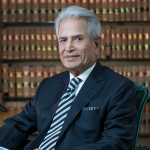
 Justice M. Jaichandren hails from an illustrious family of lawyers, academics and politicians. Justice Jaichandren majored in criminology and then qualified as a lawyer by securing a gold medal. He successfully practiced in the Madras High Court and appeared in several civil, criminal, consumer, labour, administrative and debt recovery tribunals. He held office as an Advocate for the Government (Writs Side) in Chennai and was on the panel of several government organizations as senior counsel. His true passion lay in practicing Constitutional laws with focus on writs in the Madras High Court. He was appointed Judge, High Court of Madras in December 2005 and retired in February 2017.
 S Balasubramanian is a Commerce and Law Graduate. He is a member of the Delhi Bar Council, an associate Member of the Institute of Chartered Accountants of India, the Institute of Company Secretaries of India and Management Accountants of India.