
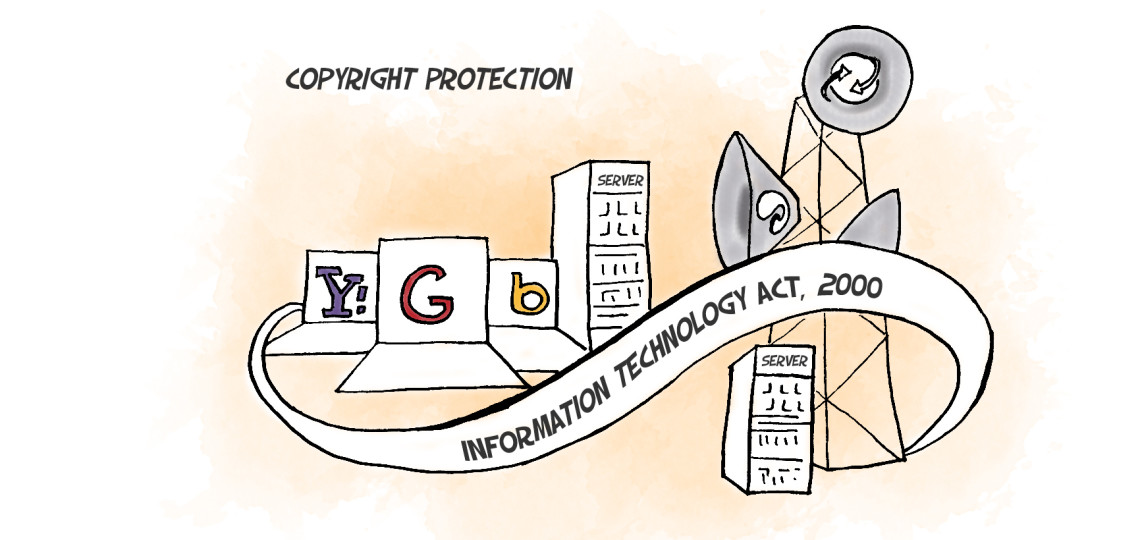
Liability and Copyright Protection of Internet Intermediaries
Copyright has always been directly connected with the technological world and the developments under it. The emergence of the digital world by the end of the twentieth century threw a new challenge to the copyright law. The Digital Technology has made possible the replication of physical material into a digitized format. This poses several problems in the traditional IPR system. Similarly, the range of contents in the websites are so vast that it requires varying levels of copyright protection. Never before has the owner’s information been so volatile, that it requires special care and protection in terms of legislation for the information. The main focus here lies with the Internet Intermediaries, the service providers to millions of internet users, who have come under the purview of several legislations to safeguard copyright.
Internet Intermediaries:
Internet Service Providers (ISP) and the search engines are collectively called as the internet intermediaries since they function as a platform for all the internet activities.
Section 2(w) of the Information Technology Act, 2000, defines ‘intermediary’ as:
“intermediary” with respect to any particular electronic message means any person who on behalf of another person receives, stores or transmits that message or provides any service with respect to that message 1.
These internet intermediaries came under the ambit of the copyright law with the contention that they aid in the infringement of copyright.
Copyright Act, 1957:
Traditional Copyright has been governed by the Copyright Act, 1957. As the Act mentions, it was enacted at a time when the world was in complete oblivion to the internet. As per the act any person who permits the infringement of copyright is criminally liable. The ISPs had contended that this legislation does not apply to them as they are just service providers and have no say in what the internet users post in the internet. The ISPs made a point mentioning that it was impossible for them to monitor all the data which travels through their servers. This lead to the inclusion of a specific legislation for ISPs in the Information Technology Act, 2000.
ISP liability under Information Technology Act, 2000:
Internet Service Provider and the Search Engines are collectively called as intermediary in the Information Technology Act. Section 79 of this Act makes the intermediaries not liable for copyright infringement in certain cases. The Intermediary has to prove that the offence or contravention was committed without their knowledge and they have no role to play in the offence or assure that all due diligence was exercised to prevent the commission of such contravention.
Exemption from Liability:
The intermediaries can claim exemption from liability by the following two factors, under the Information Technology Act.
- Lack of Knowledge
- Exercise of Due Diligence
Lack of Knowledge – The Intermediary can escape from liability if it could be proved that they were not aware of the copyright infringement. This is not possible if a notice has already been served to them to remove a particular infringing material and they have not complied with the notice.
Due Diligence – The other area where the intermediary can escape is by exercising Due Diligence. When necessary care is taken to avoid infringing material to exist in the internet, the intermediary can claim innocence from their part in terms of the offence committed.
Conclusion:
Though the Traditional Copyright law made the internet intermediaries liable for copyright infringement due to the offence done by a third party, the modern IT Act has practically made the intermediaries not liable with having due consideration to the technologies. The Intermediaries act just as a platform and they have no share in the infringement of copyright. The two-main points required for them to come out of liability are Lack of Knowledge and Due Diligence. Lack of Knowledge is self-explanatory but Due Diligence has not been defined in the Act. Thus the service provider taking necessary level of precaution itself becomes Due Diligence which makes them not liable under Copyright Infringement.
Notes:
- S, 2(w) IT Act, 2000 ↩
The Long and Short of the New Merger and Amalgamation Rules
The Companies (Incorporation) Fifth Amendment Rules, 2016
Leave a comment
You must be logged in to post a comment.

 He holds a Bachelor’s and Master’s Degree in Corporate Secretaryship and a Degree in Law. He is a Fellow member of the Institute of Company Secretaries of India and an Associate Member of the Corporate Governance Institute, UK and Ireland. He has also completed a program from ISB on ‘Value Creation through Mergers and Acquisitions.
 Mr P Muthusamy is an Indian Revenue Service (IRS) officer with an outstanding career of 30+ years of experience and expertise in all niche areas of Indirect Taxes covering a wide spectrum including GST, Customs, GATT Valuation, Central Excise and Foreign Trade.
 During his judicial role, he heard and decided a large number of cases, including some of the most sensitive, complicated, and high-stake matters on insolvency and bankruptcy, including many cases on resolution plans, shareholder disputes and Schemes of Amalgamation, De-mergers, restructuring etc.,
 Ms. Sarah Abraham has been enrolled with the Bar Council of Tamil Nadu since 1998. Her areas of practice include Shareholder Disputes, Corporate Compliances, Mergers and Acquisitions, Private Equity/ Venture Capital Agreements and allied disputes, Information Technology Contracts, Intellectual Property, General Commercial Agreements, Litigation, Arbitration and Mediation.
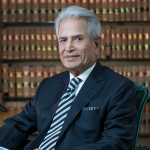 A K Mylsamy is the Founder, Managing Partner and the anchor of the firm. He holds a Degree in law and a Degree in Literature. He is enrolled with the Bar Council of Tamil Nadu.
 M Subathra holds a Degree in law and a Master’s Degree in International Business Law from the University of Manchester, United Kingdom. She is enrolled with the Bar Council of Tamil Nadu.
 Mr. K Rajendran is a former Indian Revenue Service (IRS) officer with a distinguished service of 35 years in the Indirect Taxation Department with rich experience and expertise in the fields of Customs, Central Excise, Service Tax and GST. He possesses Master’s Degree in English literature. Prior to joining the Department, he served for the All India Radio, Coimbatore for a period of about 4 years.
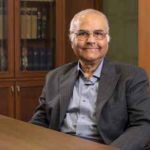 An MBA from the Indian Institute of Management, Calcutta, and an M.Sc. in Tourism Management from the Scottish Hotel School, UK, Ashok Anantram was one fo the earliest IIM graduates to enter the Indian hospitality industry. He joined India Tourism Development Corporation (ITDC) in 1970 and after a brief stint proceeded to the UK on a scholarship. On his return to India, he joined ITC Hotels Limited in 1975. Over the 30 years in this Organisation, he held senior leadership positions in Sales & Marketing and was its Vice President – Sales & Marketing. He was closely involved in decision making at the corporate level and saw the chain grow from a single hotel in 1975 to a very large multi-brand professional hospitality group.
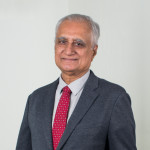 Mani holds a Bachelor Degree in Science and P.G. Diploma in Journalism and Public Relations. He has a rich and varied experience of over 4 decades in Banking, Finance, Hospitality and freelance Journalism. He began his career with Andhra Bank and had the benefit of several training programs in Banking.
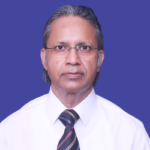 Mr. Kailash Chandra Kala joined the Department of Revenue, Ministry of Finance as ‘Customs Appraiser’ at Mumbai in the year 1993.
 S Ramanujam, is a Chartered Accountant with over 40 years of experience and specialization in areas of Corporate Tax, Mergers or Demergers, Restructuring and Acquisitions. He worked as the Executive Vice-President, Group Taxation of the UB Group, Bangalore.
 K K Balu holds a degree in B.A and B.L and is a Corporate Lawyer having over 50 years of Legal, Teaching and Judicial experience.
 Justice M. Jaichandren hails from an illustrious family of lawyers, academics and politicians. Justice Jaichandren majored in criminology and then qualified as a lawyer by securing a gold medal. He successfully practiced in the Madras High Court and appeared in several civil, criminal, consumer, labour, administrative and debt recovery tribunals. He held office as an Advocate for the Government (Writs Side) in Chennai and was on the panel of several government organizations as senior counsel. His true passion lay in practicing Constitutional laws with focus on writs in the Madras High Court. He was appointed Judge, High Court of Madras in December 2005 and retired in February 2017.
 S Balasubramanian is a Commerce and Law Graduate. He is a member of the Delhi Bar Council, an associate Member of the Institute of Chartered Accountants of India, the Institute of Company Secretaries of India and Management Accountants of India.