
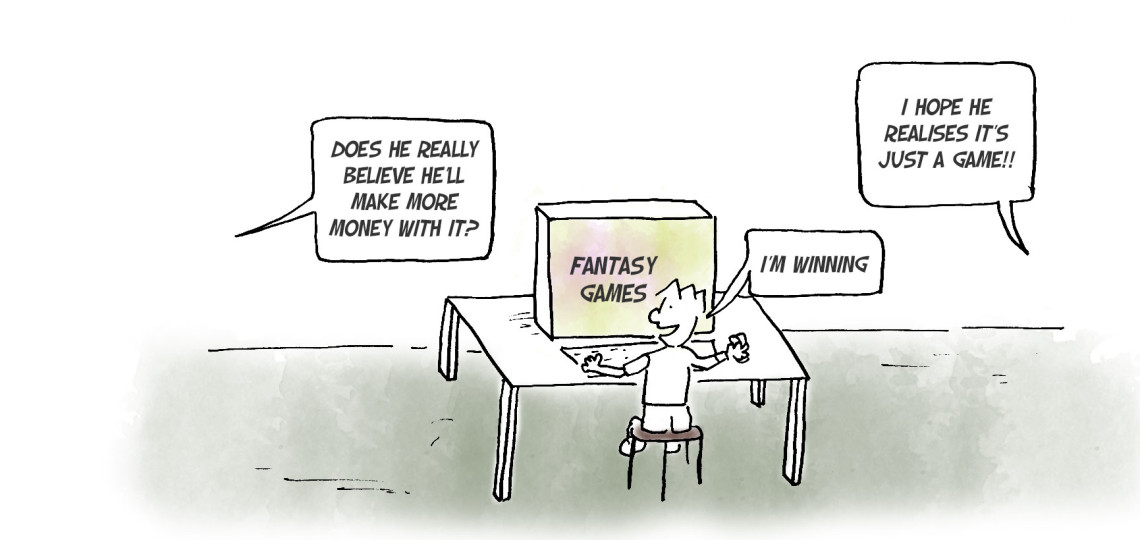
Legality of Fantasy Games in India
Fantasy Games are online games played by creating a virtual theme wherein the progress depends on the everyday updates of that field. The online games rely heavily on the statistical development and requires a huge amount of skill from the player to master these games. These fantasy games have been gaining popularity in India with the advent of many online gaming portals which demonstrate high levels of technology to attract the players.
Fantasy sports is a subset of the online fantasy games, pertaining only to the sports fraternity. While, fantasy games as a whole, involve any games played online that involves skill and correlation to the physical world, fantasy sports are teams virtually created with the players from that sport and the performance of those players online is based on their performance in the real world. Thus, an individual owning a fantasy sports team in the internet, wins according to his choice of sports players, using his skill and knowledge in the online games.
Along with technological advancements, the use of internet has exponentially increased in all aspects of life. Online gaming is one such sector that has seen a massive boom lately. The huge population of our country has provided a platform for the emergence of new online gaming portals, that attracts a large group of people, with high quality content and gaming experience. Online Gaming can be divided into two types – (i) casual gaming – without much interaction with the physical world, (ii) skill based gaming – whose outcome is determined based on the events in the real world and the player’s skill. Hence, Fantasy games can be easy classified as a fraction of the online games that are called “Skill based games”. The only discrepancy to tag along with these games is the doubt of involvement of gambling in them.
There have been controversies lately, with online gambling in these games being the question of law. The gambling laws in India have till now only focused on the physical gaming and betting. Virtual gaming is yet to be brought into the purview of gambling laws in India. Thus, putting a question mark over the legality of online Fantasy Gaming. Gambling is the involvement of money or any property during the process of the games, contributed by the players. Each player bets a certain value on an impending outcome and if the performance is the same as the predicted result, the gambler is granted with a huge prize money.
In India, Gambling and betting is prohibited by both Central and State Legislations. ‘The Public Gambling Act, 1867’ is the central enactment and it has also been adopted by a few states. The other States have their own State legislation with regards to the gambling laws. Albeit the number of gambling laws, most of these legislations were enacted before the advent of the internet, making them insufficient for the online gaming world. The laws chiefly prohibit the setting up of premises, referred to as the “gaming or the common gaming houses”, in the physical world rather than the online arena.
Gambling in the Digital media pertains to the games which are skill based and involve a lot of prediction by the player. Fantasy games are considered as skill based games as the player puts in his mental ability to analyze the situation in the physical word and perform accordingly in the digitized game. With no prominent legislation for online gaming, gambling and betting in these games are left un monitored up to the extent that there exists a difficulty in determining the nature of fantasy games and if it involves gambling.
In Dr. K.R. Lakshmanan vs State of Tamil Nadu And Anr 1, the Supreme Court held that the success of a game of skill depends on the superior knowledge of the player. When “skill” overcomes “chance”, the dominant element of skill emerges, that determine the character of the game.
Applying this Judgment, Fantasy games can be comfortably considered as skill based games which involve a lot of predictions and mental ability. Thus, the virtual games are brought under the already existing physical gambling laws of the country.
Apart from the previously enacted law, Sikkim is the first State to pass a statute on Online gaming. The Sikkim Online Gaming Act, 2008 (Regulation), enables The Sikkim State Lotteries, a government institution, as the authority to regulate online gaming in that State. Recently, Nagaland followed the accords of Sikkim and enacted a legislation on online gaming laws. The Nagaland Prohibition of Gaming and Promotion and Regulation of Online Games of Skill Act, 2016 (Gaming Act), came into force from April, 2016, focuses on curbing online gambling by using the precedent “games of skill” and issuing licences for the same. The Act permits the Licensee to earn through the “games of skill” and clarifies that any betting or wagering involving mental skill on the online platform does not amount to an offence, even though it is a punishable act under the Central and other State Physical Gambling legislations. With almost legalising the online fantasy games, there have been companies and investors trying to capitalise on the on the profits of the portals and the apps.
Lately, there has been a sudden surge in Online Trading apps, working in the same way as online gaming. The user competes for prizes by predicting the Stock Market trends within the stipulated time. The award may vary from money or money’s worth, Apple products, or any other product deemed to be fit according to the prize amount. These Apps attract various investors to be part of their business to manage with the prizes to be given to the players. The SEBI had to eventually intervene to curb the participation of the investors. On the month of August, 2016, a Press statement was released by SEBI warning the investors of such schemes. SEBI was of the view that, if any kind of dispute arises for the investors in the scheme, they cannot be resolved by the existing dispute resolution mechanisms. The investors had taken a stance that this type of online gaming apps do not involve gambling or wagering according to the general gambling laws. Yet, this stance was over looked by the SEBI, since the securities laws are special laws and override the general laws.
Though there have been conflicting decisions depending on whom the law applies, the fantasy games have been gaining steady popularity in India. People tend to get addicted to these games by spending all their time playing the games. This in turn affects the career and most importantly the health of the person. The legislations help in controlling the gaming sites so that the players are not overly affected by something which is meant to be leisurely activity.
Thus, in the current scenario, it can be said that the fantasy games are considered to be legal but with certain restrictions, with respect to the type of games hosted online. Based on the parameters of skills, online games do not come under the purview betting and wagering. At the same time, any game related to stock markets which involve investors to put in money on the games get struck by the SEBI to avoid any monetary mishap. The emergence of laws exclusively for online games in Sikkim and Nagaland is a brave new step. The enacted legislations are focused to prevent the people from being harmed due to addiction or gambling. Only future can showcase the impact of these laws and if they can curtail the gambling world both on and offline.
Notes:
- 1996 AIR 1153 ↩
Investment by Foreign Portfolio Investors (FPI) in corporate debt securities
Managerial Remuneration: Liberalising the Rigmarole of Government Approvals

Leave a comment
You must be logged in to post a comment.

 He holds a Bachelor’s and Master’s Degree in Corporate Secretaryship and a Degree in Law. He is a Fellow member of the Institute of Company Secretaries of India and an Associate Member of the Corporate Governance Institute, UK and Ireland. He has also completed a program from ISB on ‘Value Creation through Mergers and Acquisitions.
 Mr P Muthusamy is an Indian Revenue Service (IRS) officer with an outstanding career of 30+ years of experience and expertise in all niche areas of Indirect Taxes covering a wide spectrum including GST, Customs, GATT Valuation, Central Excise and Foreign Trade.
 During his judicial role, he heard and decided a large number of cases, including some of the most sensitive, complicated, and high-stake matters on insolvency and bankruptcy, including many cases on resolution plans, shareholder disputes and Schemes of Amalgamation, De-mergers, restructuring etc.,
 A K Mylsamy is the Founder, Managing Partner and the anchor of the firm. He holds a Degree in law and a Degree in Literature. He is enrolled with the Bar Council of Tamil Nadu.
 Mr. K Rajendran is a former Indian Revenue Service (IRS) officer with a distinguished service of 35 years in the Indirect Taxation Department with rich experience and expertise in the fields of Customs, Central Excise, Service Tax and GST. He possesses Master’s Degree in English literature. Prior to joining the Department, he served for the All India Radio, Coimbatore for a period of about 4 years.
 An MBA from the Indian Institute of Management, Calcutta, and an M.Sc. in Tourism Management from the Scottish Hotel School, UK, Ashok Anantram was one fo the earliest IIM graduates to enter the Indian hospitality industry. He joined India Tourism Development Corporation (ITDC) in 1970 and after a brief stint proceeded to the UK on a scholarship. On his return to India, he joined ITC Hotels Limited in 1975. Over the 30 years in this Organisation, he held senior leadership positions in Sales & Marketing and was its Vice President – Sales & Marketing. He was closely involved in decision making at the corporate level and saw the chain grow from a single hotel in 1975 to a very large multi-brand professional hospitality group.
 Mani holds a Bachelor Degree in Science and P.G. Diploma in Journalism and Public Relations. He has a rich and varied experience of over 4 decades in Banking, Finance, Hospitality and freelance Journalism. He began his career with Andhra Bank and had the benefit of several training programs in Banking.
 Mr. Kailash Chandra Kala joined the Department of Revenue, Ministry of Finance as ‘Customs Appraiser’ at Mumbai in the year 1993.
 S Ramanujam, is a Chartered Accountant with over 40 years of experience and specialization in areas of Corporate Tax, Mergers or Demergers, Restructuring and Acquisitions. He worked as the Executive Vice-President, Group Taxation of the UB Group, Bangalore.
 K K Balu holds a degree in B.A and B.L and is a Corporate Lawyer having over 50 years of Legal, Teaching and Judicial experience.
 Justice M. Jaichandren hails from an illustrious family of lawyers, academics and politicians. Justice Jaichandren majored in criminology and then qualified as a lawyer by securing a gold medal. He successfully practiced in the Madras High Court and appeared in several civil, criminal, consumer, labour, administrative and debt recovery tribunals. He held office as an Advocate for the Government (Writs Side) in Chennai and was on the panel of several government organizations as senior counsel. His true passion lay in practicing Constitutional laws with focus on writs in the Madras High Court. He was appointed Judge, High Court of Madras in December 2005 and retired in February 2017.
 S Balasubramanian is a Commerce and Law Graduate. He is a member of the Delhi Bar Council, an associate Member of the Institute of Chartered Accountants of India, the Institute of Company Secretaries of India and Management Accountants of India.