
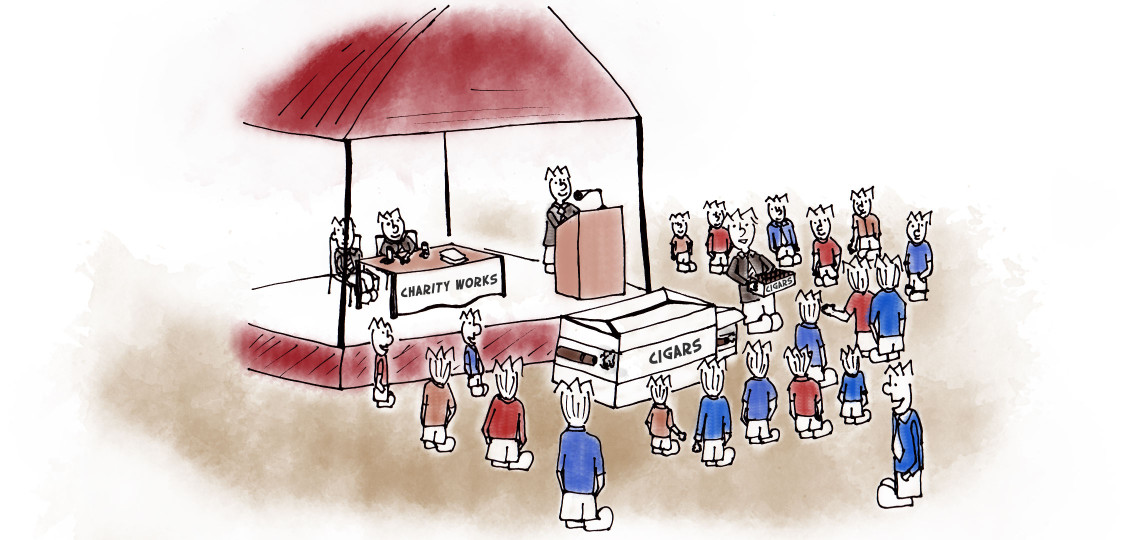
Cigars & Charity- A CSR Perspective
Companies while undertaking Corporate Social Responsibility activities under provision of the Companies Act,2013 shall not contravene any other prevailing laws of the land including Cigarettes and Other Tobacco Products Act (COTPA),2003.
Overview:
To protect the general populace from harmful effects of tobacco use, the Cigarettes and Other Tobacco Products (Prohibition of Advertisement and Regulation of Trade and Commerce, Production, Supply and Distribution) Act (COTPA), 2003 was enacted in India. Some of the features are as follows:
- The Act prohibits smoking of tobacco in public places, except in special smoking zones in hotels, restaurants and airports and open spaces.
- Advertisement of tobacco products including cigarettes is prohibited.
- Tobacco products cannot be sold to person below the age of 18 years, and in places within 100 metres radius from the outer boundary of an institution of education, which includes school colleges and institutions of higher learning established or recognized by an appropriate authority.
- Tobacco products must be sold, supplied or distributed in a package which shall contain an appropriate pictorial warning, its nicotine and tar contents.
Corporate Social Responsibility is a management concept whereby companies integrate social and environmental concerns in their business operations and interactions with their stakeholders. CSR is generally understood as being the way through which a company achieves a balance of economic, environmental and social imperatives, while at the same time addressing the expectations of shareholders and stakeholders 1.
However, Section 135 of the Companies Act 2013, requires that every company having net worth of Rupees five hundred crore or more, or turnover of rupees one thousand crore or more or a net profit of rupees five crore or more during any financial year shall spend, in every financial year, at least two percent of the average net profits of the company made during the three immediately preceding financial years, in pursuance of its Corporate Social Responsibility (CSR) policy. To spend the said amount, the company shall constitute a Corporate Social Responsibility committee that will formulate and recommend a Corporate Social Responsibility Policy which shall indicate the activities to be undertaken by the company as specified in Schedule VII of the Act. The intention behind enacting Section 135 is that companies through their CSR activities develop the local area around where it operates.
Engagement in CSR activities by tobacco industry is a more recent strategy wherein, the tobacco companies try to portray their image as being socially responsible and ethical. The industry on one hand funds activities such as youth anti-smoking programmes, reforestation campaigns and environmental camps for school children, and on the other hand continues the promotion and sale of tobacco products.
Article 5.3 of the FCTC [WHO Framework Convention on Tobacco Control] guidelines recommend, deformalizing and regulating activities described as ‘socially responsible’ by the tobacco industry.
In 2005, the WHO Framework Convention on Tobacco Control (WHO FCTC), the first treaty negotiated under the auspices of the WHO, came into force. Despite existing TAPS 2 (tobacco advertising, promotion and sponsorship) prohibition laws, tobacco industry circumvents the laws to promote their products by employing innovative and at times, covert marketing strategies. Indirect or surrogate tobacco advertising such as dark advertising, brand stretching, corporate social responsibility (CSR) activities, promotion through films and new media such as internet, discounts or free-gift offers, distribution of free samples, sale of tobacco products in the form of children’s sweets/toys, etc. gained momentum with increasing pressure on tobacco industry. 3
To protect the general populace from harmful effects of tobacco use, the Cigarettes and Other Tobacco Products (Prohibition of Advertisement and Regulation of Trade and Commerce, Production, Supply and Distribution) Act (COTPA), 2003 was enacted in India. Section 5 of COTPA prohibits all forms of TAPS in line with Article 13 of the WHO FCTC. Despite the existence of TAPS ban in India, exposure to tobacco advertising and promotion is still prevalent.
This means that CSR activities by tobacco industry is invalid since Section 5 of Cigarette and Other Tobacco Products Act (COTPA) prohibits “sponsorship of any trade mark or brand name of cigarettes or any other tobacco products”.
WHO Framework Convention on Tobacco Control (FCTC) Article 5.3 states that corporate social responsibility schemes by tobacco industry are really just marketing by another name. When the New Companies Act, 2013 came into force, it contradicted WHO FCTC Article 5.3 and Section 5 of COTPA and moreover legalized CSR activities of Tobacco Industries.
Tamil Nadu People’s Forum for Tobacco Control (TNPFTC) had filed a Public Interest litigation in Chennai High Court asking the Ministry of Corporate Affairs to Exclude Tobacco Industry from Participating in CSR activities.
Business today is no longer only about generating as much profit as possible, but business is also about being socially responsible. Following the CSR model adopted by the U.S giant Tobacco company Philip Morris as being socially and ethically responsible, Indian tobacco manufacturers who make huge profits do take this approach as a precedent and proceed with such activities. CSR activities carried on by tobacco industry are like designed public relations strategy which in turn boost up its profit making. Also they are in no way seeking to make smoking less hazardous. With the clarification issued by the Ministry of Corporate Affairs, the CSR activities of Tobacco Industry become invalid and prohibited.
Rotation of Auditors
Companies (Authorized to Register) Amendment Rules,2016.

Leave a comment
You must be logged in to post a comment.

 He holds a Bachelor’s and Master’s Degree in Corporate Secretaryship and a Degree in Law. He is a Fellow member of the Institute of Company Secretaries of India and an Associate Member of the Corporate Governance Institute, UK and Ireland. He has also completed a program from ISB on ‘Value Creation through Mergers and Acquisitions.
 Mr P Muthusamy is an Indian Revenue Service (IRS) officer with an outstanding career of 30+ years of experience and expertise in all niche areas of Indirect Taxes covering a wide spectrum including GST, Customs, GATT Valuation, Central Excise and Foreign Trade.
 During his judicial role, he heard and decided a large number of cases, including some of the most sensitive, complicated, and high-stake matters on insolvency and bankruptcy, including many cases on resolution plans, shareholder disputes and Schemes of Amalgamation, De-mergers, restructuring etc.,
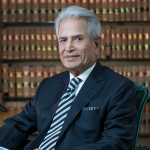 A K Mylsamy is the Founder, Managing Partner and the anchor of the firm. He holds a Degree in law and a Degree in Literature. He is enrolled with the Bar Council of Tamil Nadu.
 Mr. K Rajendran is a former Indian Revenue Service (IRS) officer with a distinguished service of 35 years in the Indirect Taxation Department with rich experience and expertise in the fields of Customs, Central Excise, Service Tax and GST. He possesses Master’s Degree in English literature. Prior to joining the Department, he served for the All India Radio, Coimbatore for a period of about 4 years.
 An MBA from the Indian Institute of Management, Calcutta, and an M.Sc. in Tourism Management from the Scottish Hotel School, UK, Ashok Anantram was one fo the earliest IIM graduates to enter the Indian hospitality industry. He joined India Tourism Development Corporation (ITDC) in 1970 and after a brief stint proceeded to the UK on a scholarship. On his return to India, he joined ITC Hotels Limited in 1975. Over the 30 years in this Organisation, he held senior leadership positions in Sales & Marketing and was its Vice President – Sales & Marketing. He was closely involved in decision making at the corporate level and saw the chain grow from a single hotel in 1975 to a very large multi-brand professional hospitality group.
 Mani holds a Bachelor Degree in Science and P.G. Diploma in Journalism and Public Relations. He has a rich and varied experience of over 4 decades in Banking, Finance, Hospitality and freelance Journalism. He began his career with Andhra Bank and had the benefit of several training programs in Banking.
 Mr. Kailash Chandra Kala joined the Department of Revenue, Ministry of Finance as ‘Customs Appraiser’ at Mumbai in the year 1993.
 S Ramanujam, is a Chartered Accountant with over 40 years of experience and specialization in areas of Corporate Tax, Mergers or Demergers, Restructuring and Acquisitions. He worked as the Executive Vice-President, Group Taxation of the UB Group, Bangalore.
 K K Balu holds a degree in B.A and B.L and is a Corporate Lawyer having over 50 years of Legal, Teaching and Judicial experience.
 Justice M. Jaichandren hails from an illustrious family of lawyers, academics and politicians. Justice Jaichandren majored in criminology and then qualified as a lawyer by securing a gold medal. He successfully practiced in the Madras High Court and appeared in several civil, criminal, consumer, labour, administrative and debt recovery tribunals. He held office as an Advocate for the Government (Writs Side) in Chennai and was on the panel of several government organizations as senior counsel. His true passion lay in practicing Constitutional laws with focus on writs in the Madras High Court. He was appointed Judge, High Court of Madras in December 2005 and retired in February 2017.
 S Balasubramanian is a Commerce and Law Graduate. He is a member of the Delhi Bar Council, an associate Member of the Institute of Chartered Accountants of India, the Institute of Company Secretaries of India and Management Accountants of India.