
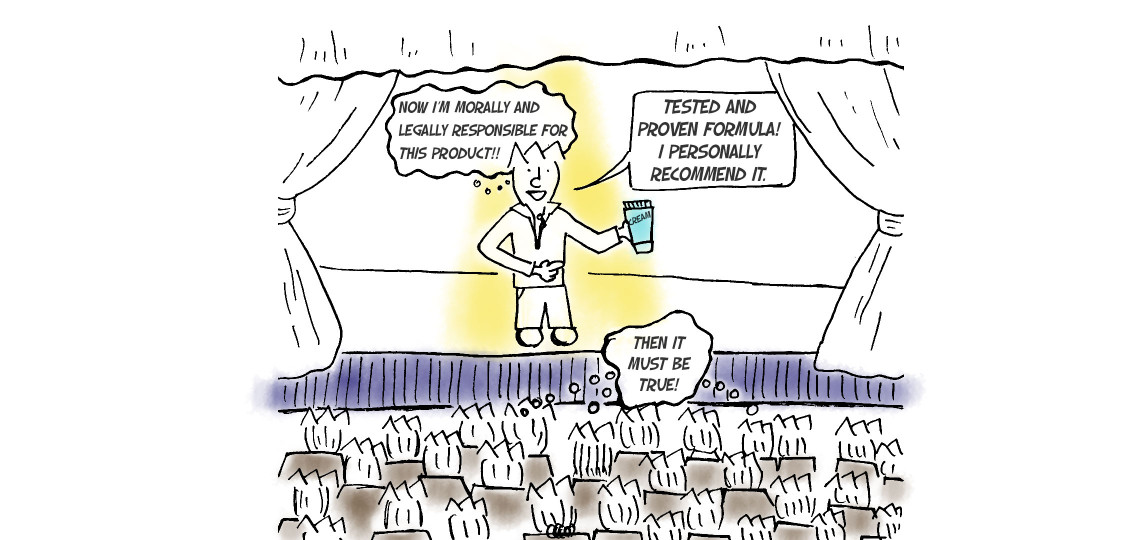
Celebrity endorsers likely to face fine and imprisonment for misleading advertisements
Celebrities who endorse brand in misleading advertisement or back products that fail to live up to claims may face the threat of imprisonment or paying of hefty fines if the new draft of the Consumer Protection bill is cleared in its present shape. The Consumer Protection Bill, 2015 was introduced in the Lok Sabha on August 29, 2015 repealing the 30 years old Consumer Protection Act, 1986 which has become outdated on account of changes in technologies and the rapid growth of online shopping retailers. However, the Parliamentary Committee recommended various amendments to the Consumer Protection Bill, 2015. The Consumer Affairs Ministry has considered the recommendations made by the Committee and a new bill namely The Consumer Protection Bill, 2016 will be presented incorporating the recommendations.
Some of the key recommendations of the report of the Standing Parliamentary Committee to the Consumer Protection Bill, 2015 are:
- The fresh draft does not differentiate between the manufacturers/service providers and celebrities when it comes to punishments for misleading ads.
- Section 75B provides for liability of an endorser: “Whoever makes an endorsement which is false or misleading and prejudicial to the interest of any consumer shall be punishable with imprisonment for a term which may extend to two years and with fine which may extend to ten lakh rupees; and for the second and subsequent offences, be punishable with imprisonment for a term which may extend to five years and fine which may extend to fifty lakh rupees,”
- Section 75A makes a manufacturer and service provider also legally responsible for any false and misleading advertisements, and prescribes penalties in the same manner in which celebrity brand ambassadors have been made liable.
- According to Section 17A, an individual, group or an institution could be an endorser.
- Section 17B defines endorsement in the widest way possible as “any message, verbal statement, demonstration” or depiction of the name, signature, likeness or other identifying personal characteristics of an individual or the name or seal of an organization“which make the consumer to believe that it reflects the opinion, findings or experience of the person making such endorsement”.
The rationale behind the Amendment
The issue has gained importance after Maggi noodles which was endorsed by movie actors such as Amitabh Bachchan, Madhuri Dixit and Preity Zinta were found with presence of excess lead and monosodium glutamate. Later, Cricketer M S Dhoni who endorsed realty firm Amarpali resigned as brand ambassador after the unhappy residents of a housing project in Noida launched a social media campaign asking the cricketer to disassociate himself from the builder.
The uproar over the Maggi reports made the Government realize the importance to ascertain the legal and professional liability of the brand ambassadors who repose trust and credibility by endorsing a particular brand in ways that other types of advertising cannot. The consumers tend to believe advertisements promoted by eminent personalities or celebrities blindly without making any kind of analysis. But when the unfair trade practices are in fact exposed, the celebrities quickly disassociate themselves with the products/companies they are representing.
The various statutory remedies available to aggrieved consumer in India are:
- filing a case in a consumer court for unfair trade practice under the Consumer Protection Act, 1986.
- seeking remedy under Section 24 of the Food Safety and Standards Act, 2006 (FSSA) in case of any false claims about the nutritional value or efficacy of the product without providing any scientific justification.
- Seeking remedy under Sections 270, 273, 276 and 420 of the Indian Penal Code, 1860.
- Writing a complaint to Advertising Standards Council of India (ASCI).
- Making a claim under the law of torts against the endorser.
None of the above mentioned provisions specifically hold the celebrities liable for their acts. Brand ambassadors are engaged by the advertising agency and not the company and their rights and obligations are governed by the contract between the endorser and advertising agency, there being no contractual relations between the company and the endorser. Moreover, most of the times the agreements contain indemnity clauses where by the celebrities are indemnified against any civil liability. Hence, there was a need for amending the consumer laws in order to hold the celebrities liable for misleading advertisements.
A brief analysis of the Amendment
The official amendment redefines advertisement by adding endorsement as one of the facets of advertisement. Section 17A states that any individual, group or institution as endorser which means that medical, dental and other associations also come within the ambit of endorsers and they could be held liable in case of misleading advertisements.
Section 75B seems to be little harsh on the endorsers as it provides for jail term for celebrities who endorse products or services for a fixed monetary consideration. The provision provides for imprisonment “and” fine without conferring any discretion to the Judge on the point of sentence. The proviso to Section 75B allows a celebrity to escape from liability by proving that he or she took reasonable precautions and exercised due diligence before endorsing the product or service but mistaken belief will not be allowed as a defence. He/she could also be liable in case it is proved that he or she had falsely claimed to have been using a product. Section 75B seeks to penalize only recklessness endorsements by brand ambassadors who proceed to exercise their influence on consumers without paying heed to the veracity and truthfulness of the claims made by the products. The Section does not make celebrities vicariously liable if something goes wrong but imposes a legal obligation to exercise proper due diligence before endorsing a product. The punishment of imprisonment is bit harsh on the celebrities and deliberations are taking place to impose exemplary damages instead of imprisonment. The amount of damages to be paid by the endorser will have to be linked to the sale volumes of the product or service.
Though the provision may seem to favour consumers, there are adequate protection measures to celebrities against harassment with cases filed by consumers across the country. The proposed law state that a court can take cognizance of an offence under this Section only on the receipt of a written complaint filed by or on behalf of the Central Consumer Protection Authority, a new executive agency to be constituted by the Central Government to protect, promote and enforce the rights of consumers. Also, the new law provides for compounding or settlement of the first offence by the brand ambassadors and the Central Authority has been empowered to do so. The result would be that a charge of false and misleading advertisement can be dropped if the brand ambassador shells out monetary damages. If the prosecution has already begun in a trial court, the Central Authority could still discharge the brand ambassador by moving an application before the court. The Bill also lays down that no proceeding, judicial or otherwise, can be instituted against a brand ambassador if the offence has been compounded under the law. The effect of the provision is that the power to commence prosecution of a celebrity brand ambassador will lie with an executive wing of the Government and it is not open to a consumer to independently press charges against the ambassadors in a court for false and misleading ads.
International scenario
In US, the Federal Trade Commission (FTC), the competition law regulator, has prescribed certain guidelines for endorsements by celebrities. It has also prescribed standards for endorsers and when an endorser could be held liable. The endorsers will be held liable by applying the ‘good reason to believe’ test. In Europe, a voluntary self-imposed code precludes celebrities from endorsing medicines, medical treatments, tobacco and alcohol. In China, there are instances where endorsers were prosecuted for making misleading claims.
Conclusion
when Companies are considered as persons with corporate social responsibility, the law is bound to regulate the conduct of celebrities who play a vital role in modern culture and consumption patterns serving as deciders of taste, style and public opinion the world over. Marketers employ the celebrity power to create an emotional bond with the consumers for boosting the sales volumes. While a celebrity has the influence masses, he/she is also morally responsible for leading the people in the right direction. Hence it is desirable to cast minimum threshold of responsibilities upon celebrities endorsing products in a country like India where consumers are driven by their statements. If the present amendments are implemented, the business of brand ambassadors will become more judicious as the celebrities would become more cautious in deciding to endorse products.
Standardization and simplification of producers for Transmission of securities
SARFAESI (Amendment) Act, 2016 – A New Life for Banks and other Secured Creditors

Leave a comment
You must be logged in to post a comment.

 He holds a Bachelor’s and Master’s Degree in Corporate Secretaryship and a Degree in Law. He is a Fellow member of the Institute of Company Secretaries of India and an Associate Member of the Corporate Governance Institute, UK and Ireland. He has also completed a program from ISB on ‘Value Creation through Mergers and Acquisitions.
 Mr P Muthusamy is an Indian Revenue Service (IRS) officer with an outstanding career of 30+ years of experience and expertise in all niche areas of Indirect Taxes covering a wide spectrum including GST, Customs, GATT Valuation, Central Excise and Foreign Trade.
 During his judicial role, he heard and decided a large number of cases, including some of the most sensitive, complicated, and high-stake matters on insolvency and bankruptcy, including many cases on resolution plans, shareholder disputes and Schemes of Amalgamation, De-mergers, restructuring etc.,
 A K Mylsamy is the Founder, Managing Partner and the anchor of the firm. He holds a Degree in law and a Degree in Literature. He is enrolled with the Bar Council of Tamil Nadu.
 Mr. K Rajendran is a former Indian Revenue Service (IRS) officer with a distinguished service of 35 years in the Indirect Taxation Department with rich experience and expertise in the fields of Customs, Central Excise, Service Tax and GST. He possesses Master’s Degree in English literature. Prior to joining the Department, he served for the All India Radio, Coimbatore for a period of about 4 years.
 An MBA from the Indian Institute of Management, Calcutta, and an M.Sc. in Tourism Management from the Scottish Hotel School, UK, Ashok Anantram was one fo the earliest IIM graduates to enter the Indian hospitality industry. He joined India Tourism Development Corporation (ITDC) in 1970 and after a brief stint proceeded to the UK on a scholarship. On his return to India, he joined ITC Hotels Limited in 1975. Over the 30 years in this Organisation, he held senior leadership positions in Sales & Marketing and was its Vice President – Sales & Marketing. He was closely involved in decision making at the corporate level and saw the chain grow from a single hotel in 1975 to a very large multi-brand professional hospitality group.
 Mani holds a Bachelor Degree in Science and P.G. Diploma in Journalism and Public Relations. He has a rich and varied experience of over 4 decades in Banking, Finance, Hospitality and freelance Journalism. He began his career with Andhra Bank and had the benefit of several training programs in Banking.
 Mr. Kailash Chandra Kala joined the Department of Revenue, Ministry of Finance as ‘Customs Appraiser’ at Mumbai in the year 1993.
 S Ramanujam, is a Chartered Accountant with over 40 years of experience and specialization in areas of Corporate Tax, Mergers or Demergers, Restructuring and Acquisitions. He worked as the Executive Vice-President, Group Taxation of the UB Group, Bangalore.
 K K Balu holds a degree in B.A and B.L and is a Corporate Lawyer having over 50 years of Legal, Teaching and Judicial experience.
 Justice M. Jaichandren hails from an illustrious family of lawyers, academics and politicians. Justice Jaichandren majored in criminology and then qualified as a lawyer by securing a gold medal. He successfully practiced in the Madras High Court and appeared in several civil, criminal, consumer, labour, administrative and debt recovery tribunals. He held office as an Advocate for the Government (Writs Side) in Chennai and was on the panel of several government organizations as senior counsel. His true passion lay in practicing Constitutional laws with focus on writs in the Madras High Court. He was appointed Judge, High Court of Madras in December 2005 and retired in February 2017.
 S Balasubramanian is a Commerce and Law Graduate. He is a member of the Delhi Bar Council, an associate Member of the Institute of Chartered Accountants of India, the Institute of Company Secretaries of India and Management Accountants of India.