
Selective reduction of Capital – a balancing act
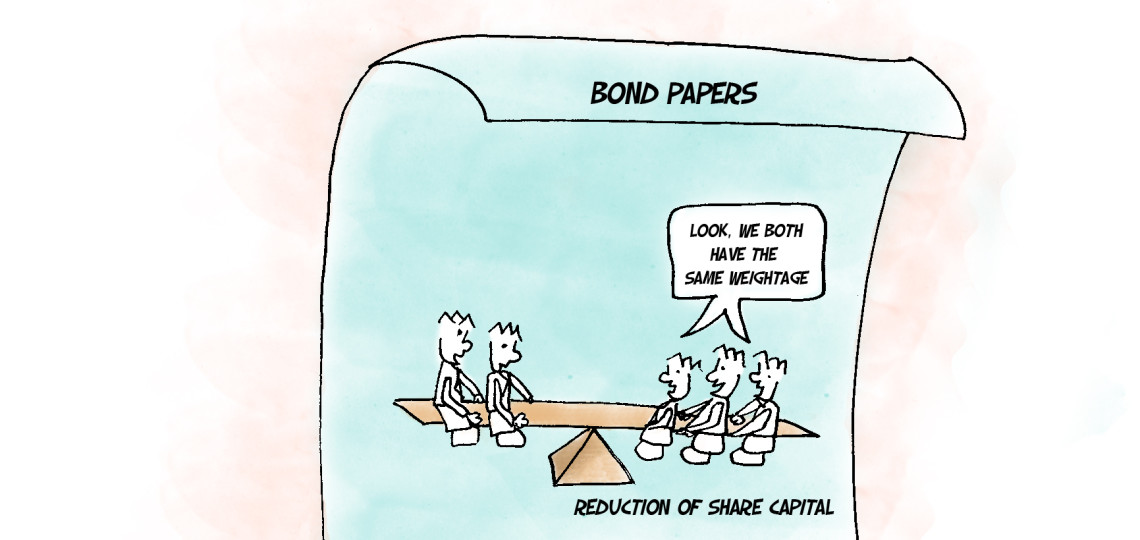
Reduction of share capital is a very important aspect of the capital management of the company. It is a mechanism whereby the company reduces its capital through various means and for various ends. While an equal reduction in capital applies to the same proportion of shares and on the same terms and conditions for each shareholder, selective reduction differentiates between shareholders of the same class by resulting in the compulsory extinguishment of capital of some shareholders. In the last couple of years, companies have increasingly resorted to selective reduction of capital of the company.
Courts’ view:
In the Panruti Industrial Co. (P) Ltd 1 the Madras HC held that the prescribed majority of the shareholders is entitled to decide whether there should be a reduction of capital, and, if so, in what manner and to what extent it should be carried into effect. However, companies seemed to resort to selective reduction of capital as a legitimate tool to oust minority shareholders. This was particularly true in case of family owned companies where majority of shares are held by members of the same family or group. Even if family owned corporates, there have been instances where scheme of reduction of capital was used to oust a segment of the family that held minority stake. Over time, the Courts have become stringent about approving schemes of selective reduction. In Sandvik Asia Ltd Vs Bharat Kumar Padamsi & Others 2, the division bench of the Delhi HC observed that if the non-promoter shareholders were being paid fair value of their shares, there was nothing invalid in such proposal of selective reduction. The decision in the case Reckitt Benckiser (India) Ltd 3 reiterated that in determining whether a scheme for selective reduction of capital, which differentiates between shareholders of one class, is fair and equitable, it would be most relevant to consider whether the affected shareholders were treated as a separate sub-class for meetings to approve the scheme or whether the scheme contained any other safeguard to prevent a forced acquisition of shares of the targeted shareholders.
In deciding the legality of the scheme of selective reduction, Courts maintain ensure that they do not sanction a scheme of reduction which is discriminatory, unfair and malafide to minority shareholders / non-promoter shareholders / public shareholders. At the same time, the Court also reiterated that any person or group of persons holding miniscule shareholding in a company cannot defeat a scheme that has been duly approved by majority of shareholders. The Courts have observed that so long as the procedure laid down in law has been duly followed, there is no reason why a scheme of selective reduction shall be rejected on grounds of affecting minority shareholders.
Conclusion:
A company limited by shares is permitted to reduce its shares in any manner, provided it is within the framework of law. The broad framework within which reduction of share capital (equal or selective) is allowed is (a) if it considered fair and reasonable to the shareholders as a whole and (b) does not affect the interests of creditors and shareholders. Courts are cautious in ensuring that a scheme for reduction is not a façade by majority shareholders to forcibly acquire shareholding of minorities’ shareholding.
Selective reduction of share capital is truly a double-edged sword in the hands of the Management of the company. While the Courts have in many instances sanctioned scheme(s) of selective reduction of share capital, any scheme that does not provide for uniform treatment of shareholders, will not find favour with the Court. The bottom line is to ensure shareholder interests have been secured in just and equitable manner.



 He holds a Bachelor’s and Master’s Degree in Corporate Secretaryship and a Degree in Law. He is a Fellow member of the Institute of Company Secretaries of India and an Associate Member of the Corporate Governance Institute, UK and Ireland. He has also completed a program from ISB on ‘Value Creation through Mergers and Acquisitions.
 Mr P Muthusamy is an Indian Revenue Service (IRS) officer with an outstanding career of 30+ years of experience and expertise in all niche areas of Indirect Taxes covering a wide spectrum including GST, Customs, GATT Valuation, Central Excise and Foreign Trade.
 During his judicial role, he heard and decided a large number of cases, including some of the most sensitive, complicated, and high-stake matters on insolvency and bankruptcy, including many cases on resolution plans, shareholder disputes and Schemes of Amalgamation, De-mergers, restructuring etc.,
 A K Mylsamy is the Founder, Managing Partner and the anchor of the firm. He holds a Degree in law and a Degree in Literature. He is enrolled with the Bar Council of Tamil Nadu.
 Mr. K Rajendran is a former Indian Revenue Service (IRS) officer with a distinguished service of 35 years in the Indirect Taxation Department with rich experience and expertise in the fields of Customs, Central Excise, Service Tax and GST. He possesses Master’s Degree in English literature. Prior to joining the Department, he served for the All India Radio, Coimbatore for a period of about 4 years.
 An MBA from the Indian Institute of Management, Calcutta, and an M.Sc. in Tourism Management from the Scottish Hotel School, UK, Ashok Anantram was one fo the earliest IIM graduates to enter the Indian hospitality industry. He joined India Tourism Development Corporation (ITDC) in 1970 and after a brief stint proceeded to the UK on a scholarship. On his return to India, he joined ITC Hotels Limited in 1975. Over the 30 years in this Organisation, he held senior leadership positions in Sales & Marketing and was its Vice President – Sales & Marketing. He was closely involved in decision making at the corporate level and saw the chain grow from a single hotel in 1975 to a very large multi-brand professional hospitality group.
 Mani holds a Bachelor Degree in Science and P.G. Diploma in Journalism and Public Relations. He has a rich and varied experience of over 4 decades in Banking, Finance, Hospitality and freelance Journalism. He began his career with Andhra Bank and had the benefit of several training programs in Banking.
 Mr. Kailash Chandra Kala joined the Department of Revenue, Ministry of Finance as ‘Customs Appraiser’ at Mumbai in the year 1993.
 S Ramanujam, is a Chartered Accountant with over 40 years of experience and specialization in areas of Corporate Tax, Mergers or Demergers, Restructuring and Acquisitions. He worked as the Executive Vice-President, Group Taxation of the UB Group, Bangalore.
 K K Balu holds a degree in B.A and B.L and is a Corporate Lawyer having over 50 years of Legal, Teaching and Judicial experience.
 Justice M. Jaichandren hails from an illustrious family of lawyers, academics and politicians. Justice Jaichandren majored in criminology and then qualified as a lawyer by securing a gold medal. He successfully practiced in the Madras High Court and appeared in several civil, criminal, consumer, labour, administrative and debt recovery tribunals. He held office as an Advocate for the Government (Writs Side) in Chennai and was on the panel of several government organizations as senior counsel. His true passion lay in practicing Constitutional laws with focus on writs in the Madras High Court. He was appointed Judge, High Court of Madras in December 2005 and retired in February 2017.
 S Balasubramanian is a Commerce and Law Graduate. He is a member of the Delhi Bar Council, an associate Member of the Institute of Chartered Accountants of India, the Institute of Company Secretaries of India and Management Accountants of India.