
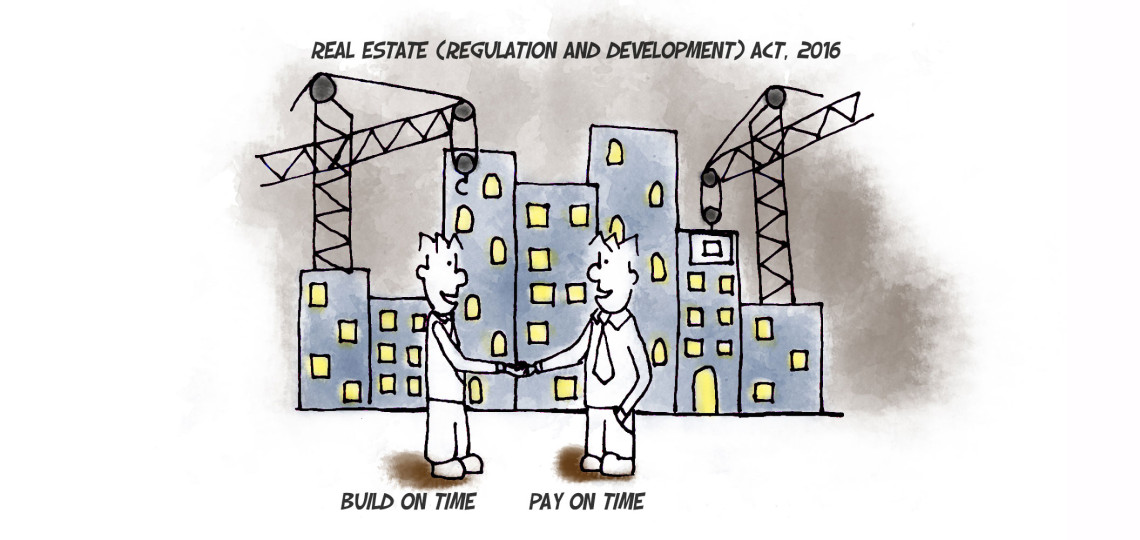
Real Estate (Regulation and Development) Act, 2016
The Real Estate (Regulation and Development) Act, 2016 ‘(‘Act’) was enacted for the following purposes:
- To regulate and promote the real estate sector;
- to ensure sale of plots, apartments or buildings in an efficient and transparent manner;
- to protect the interest of the consumers in the real estate sector;
- to establish an adjudicating mechanism for speedy dispute redressal.
The Act received the President’s Assent on 25th March 2016. However, the Act is yet to be notified.
Applicability of the Act:
- The players in the real estate market are Promoters 1, Allottees 2 and Real Estate Agents 3.
- The Act applies to “Real Estate Projects”. The expression “Real Estate Project” is defined in Section 2(zn) of the Act as meaning the following activities:
- the development of a building or a building consisting of apartments, or
- converting an existing building or a part thereof into apartments, or
- the development of land into plots or apartments, for the purpose of selling all or some of the said apartments or plots or building.
- “Real Estate Projects” also includes the “Common Areas” 4, the development works, all improvements and structures and all easement, rights and appurtenances.
- The Act covers both residential as well as commercial Real Estate Projects.
- The Act will apply to projects that are ongoing on the date of commencement of the Act for which completion certificate has not been issued.
Registration of Real Estate Project and Real Estate Agents:
- The registration of a Real Estate Project is compulsory in cases where the area of land proposed to be developed exceeds 500 square meters or the number of apartments proposed to be developed exceeds Eight 5.
- An obligation is cast upon a Real Estate Agent not to facilitate sale or purchase of any plot, apartment or building, as the case may be, without registering himself with the Real Estate Regulatory Authority (RERA) 6.
Obligations of the Promoter:
The following are some of the obligations of the Promoter under the Act:
- Mandatory registration of the Real Estate Projects with RERA.
- Creation of a separate bank account to deposit amount realized from allottees.
- Entering into agreements for sale with the allottee and getting the same registered under local state law.
- Creation of promoter’s webpage on the website of RERA for public viewing.
- Declaration that the project land has legal title or authentication of validity of title, if such land is owned by another person.
- Requirement to obtain insurance for title and buildings along with construction insurance.
Restrictions imposed on Promoters and Agents:
The following are certain restrictions imposed on Promoters and Agents:
- Prohibition from creating any charge or encumbrance on any apartment after executing an agreement for the same.
- Prohibition from alteration of plans, structural designs and specifications of the land, apartment or building without prior consent of two-third of the allottees.
- Prohibition of real estate agents from facilitating any sale or purchase of plots/apartments in projects without obtaining registration with the RERA. The agents are required to facilitate access of project information to consumers at the time of booking and refrain from making false statements, misleading representations and indulging in unfair trade practices.
Rights of Allottees:
The following are certain rights of the Allottees:
- Right to information relating to sanctioned plans, layout plans along with specifications approved by the competent authority. 7
- Right to claim possession of the apartment, plot or building 8.
- Right to claim compensation or interest from Promoter for breach of agreement of sale.
- Right to execution of registered agreement of sale before being called upon to pay amounts in excess of 10 percent of cost of flat/plot/apartment. 9
- Right against alterations to project without consent. 10
- Right to participate towards the formation of an association or society or cooperative society of the allottees.
- Right against transfer or assignment of project by promoter to third party without consent. 11
- Right to claim compensation from promoter for loss caused by defective tittle. 12
- Right to transfer of title insurance and other insurance. 13
Redressal Mechanism:

Also, no civil court shall have jurisdiction to entertain any suit or proceeding in respect of any matter which the Authority or the adjudicating officer or the Appellate Tribunal is empowered under the Act.
Conclusion:
The Act sets standards for the real estate sector. Governance and regulation through the Act for the sector is likely to benefit all the stakeholders.
Notes:
- Section 2(zk) of the Act ↩
- Section 2(d) of the Act ↩
- Section 2(zm) of the Act ↩
- Section 2(n) of the Act ↩
- Section 3 of the Act ↩
- Section 9 of the Act ↩
- Section 19(1) & (2) of the Act ↩
- Section 19(3) of the Act ↩
- Section 13 of the Act ↩
- Section 14(1) of the Act ↩
- Section 15 of the Act ↩
- Section 18(2) of the Act ↩
- Section 16(3) of the Act ↩
Exit offer is exempted from the restriction on contra trade
Central Government makes certain amendments to Schedule III of the Companies Act,2013



Leave a comment
You must be logged in to post a comment.

 He holds a Bachelor’s and Master’s Degree in Corporate Secretaryship and a Degree in Law. He is a Fellow member of the Institute of Company Secretaries of India and an Associate Member of the Corporate Governance Institute, UK and Ireland. He has also completed a program from ISB on ‘Value Creation through Mergers and Acquisitions.
 Mr P Muthusamy is an Indian Revenue Service (IRS) officer with an outstanding career of 30+ years of experience and expertise in all niche areas of Indirect Taxes covering a wide spectrum including GST, Customs, GATT Valuation, Central Excise and Foreign Trade.
 During his judicial role, he heard and decided a large number of cases, including some of the most sensitive, complicated, and high-stake matters on insolvency and bankruptcy, including many cases on resolution plans, shareholder disputes and Schemes of Amalgamation, De-mergers, restructuring etc.,
 A K Mylsamy is the Founder, Managing Partner and the anchor of the firm. He holds a Degree in law and a Degree in Literature. He is enrolled with the Bar Council of Tamil Nadu.
 Mr. K Rajendran is a former Indian Revenue Service (IRS) officer with a distinguished service of 35 years in the Indirect Taxation Department with rich experience and expertise in the fields of Customs, Central Excise, Service Tax and GST. He possesses Master’s Degree in English literature. Prior to joining the Department, he served for the All India Radio, Coimbatore for a period of about 4 years.
 An MBA from the Indian Institute of Management, Calcutta, and an M.Sc. in Tourism Management from the Scottish Hotel School, UK, Ashok Anantram was one fo the earliest IIM graduates to enter the Indian hospitality industry. He joined India Tourism Development Corporation (ITDC) in 1970 and after a brief stint proceeded to the UK on a scholarship. On his return to India, he joined ITC Hotels Limited in 1975. Over the 30 years in this Organisation, he held senior leadership positions in Sales & Marketing and was its Vice President – Sales & Marketing. He was closely involved in decision making at the corporate level and saw the chain grow from a single hotel in 1975 to a very large multi-brand professional hospitality group.
 Mani holds a Bachelor Degree in Science and P.G. Diploma in Journalism and Public Relations. He has a rich and varied experience of over 4 decades in Banking, Finance, Hospitality and freelance Journalism. He began his career with Andhra Bank and had the benefit of several training programs in Banking.
 Mr. Kailash Chandra Kala joined the Department of Revenue, Ministry of Finance as ‘Customs Appraiser’ at Mumbai in the year 1993.
 S Ramanujam, is a Chartered Accountant with over 40 years of experience and specialization in areas of Corporate Tax, Mergers or Demergers, Restructuring and Acquisitions. He worked as the Executive Vice-President, Group Taxation of the UB Group, Bangalore.
 K K Balu holds a degree in B.A and B.L and is a Corporate Lawyer having over 50 years of Legal, Teaching and Judicial experience.
 Justice M. Jaichandren hails from an illustrious family of lawyers, academics and politicians. Justice Jaichandren majored in criminology and then qualified as a lawyer by securing a gold medal. He successfully practiced in the Madras High Court and appeared in several civil, criminal, consumer, labour, administrative and debt recovery tribunals. He held office as an Advocate for the Government (Writs Side) in Chennai and was on the panel of several government organizations as senior counsel. His true passion lay in practicing Constitutional laws with focus on writs in the Madras High Court. He was appointed Judge, High Court of Madras in December 2005 and retired in February 2017.
 S Balasubramanian is a Commerce and Law Graduate. He is a member of the Delhi Bar Council, an associate Member of the Institute of Chartered Accountants of India, the Institute of Company Secretaries of India and Management Accountants of India.