
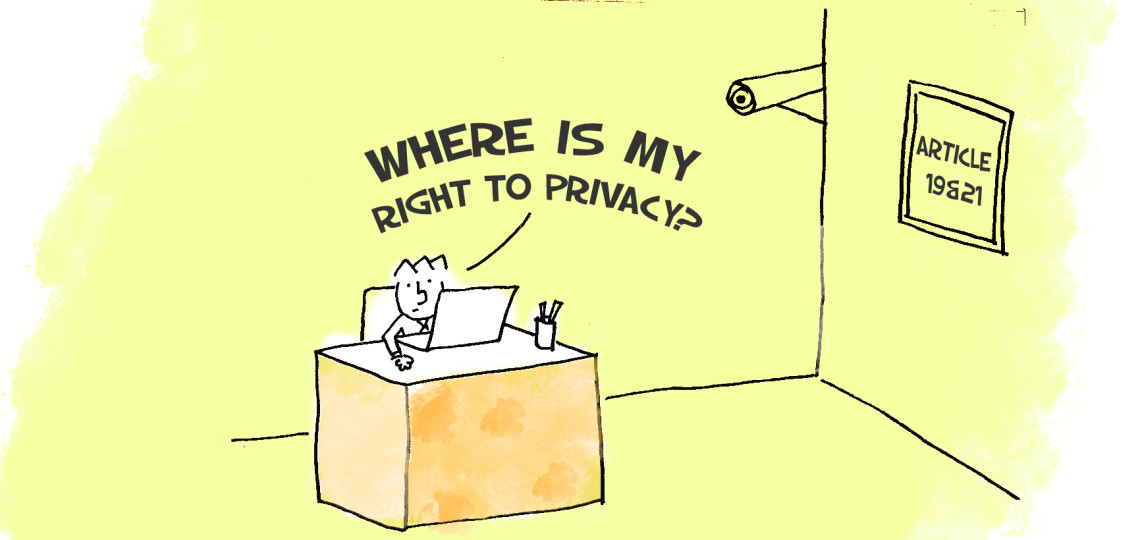
Is our Private Life Really Private? – Right to Privacy
Privacy is a concept that is deeply rooted in history and religion. The importance of Privacy has been recognised throughout the world from time immemorial. George Orwell, a famous English writer, once said that there would come a time when each and every activity of the people would be monitored. His novels were always dominated by the idea of loss of an individual’s liberty. His fears have somewhat come true in this era of information. Individual Privacy is in greater danger than ever before not only because of the advanced technologies which can be used to track any person, but also due to the showcase of one’s own life in various social media platforms. A person’s life is made available to the world in a canvas. To understand the importance of Privacy, we need to dwell deeper into the legality of the Right to Privacy.
Right to Privacy:
Though Privacy has existed from a very long time, defining the term in concise manner is difficult. Various jurists and philosophers have tried defining ‘privacy’ but were not able to consolidate the expression in a few sentences. Justice Louis Brandeis of the US Supreme Court, in the year 1890, urged that it was an individual’s “right to be let alone” 1. The legal system was founded for the physical protection of a person or his property. But with the dawn of the Information and Communication Revolution, it became a necessity for the protection of mon’s privacy so much so that Right to Privacy is now being considered as a basic Human Right. Many Human Rights activists vouch for privacy to be protected and are against any practice which infringes a person’s privacy.
Privacy as a Human Right:
Recognising Privacy as a Fundamental Human Right is a modern thought. Since Privacy has been a part of various cultures from a very long time, the meaning of privacy is highly dependent on a nation’s culture. Privacy as Human Right concept evolved from the Tort law in the common-law countries. The basis for Privacy rights started by defying the notion – “the King can do no wrong”. People vouched for their privacy and the Justice system went to the extent of prosecuting the Kings for breach of Privacy of the citizens. The common-law system paved way for several international Conventions in the post-World War II scenario, with the most important international covenant being he Universal Declaration of Human Rights.
Universal Declaration of Human Rights:
The UDHR is a milestone in the field of Human Rights. The international covenant which was adopted in the year 1948, contains every aspect of the Human Rights. Article 12 of the UDHR says that every person is entitled to his privacy and there should be no interference from a third person into his private life. Many Countries have adopted and ratified the UDHR as a law, and also have inducted the Right to Privacy as separate legislations. As far as India is concerned, there is no specific law for right to Privacy. The Constitution of India and the Fundamental Rights within serve the Purpose of safeguarding Rights of its citizens.
Right to Privacy and The Indian Constitution
Articles 19 and 21 are the most important Articles for the Privacy Rights as there is no separate Fundamental Right which defines Right to Privacy. The Courts have carved out the Right to Privacy from the “Right to Freedom” in Art. 19 and “Right to Life” Art. in 21. This Constitutional Right to privacy contained in Right to life must be read with the freedom to publish or propagate a private matter. There were several cases decided by the Supreme Court that emphasised the importance of Privacy by the virtue of Art. 21 and have rendered justice to the citizens. Though the Supreme Court made a constitutional right for Privacy, from the existing Fundamental Rights, it is the truth that there are no special legislation or clauses which caters as a Right to Privacy Law unlike other Countries.
Scenario in other Countries and Data Protection Act:
Several Common-law countries have enacted Privacy laws. The Preamble of the Australian Privacy Charter provide that people have their right to privacy of their own body, private space and information privacy. Article 11 in the American Convention on Human Rights also validates the Right to Privacy in their Country. Further, Canada and the many European nations have Data Protection Acts which protect the privacy of the information stored in the internet or carried in a portable device. Hence, it can be easily said that Right to Privacy is an essential phenomenon which will see more developments in the future.
Conclusion:
Humans treasure Privacy and connect the same with their personal freedom. Having a private life and safeguarding the well-being of oneself has been existing from ancient times. Thus, it is not new that people want to have their Right to Privacy and would knock the doors of the Judges for the enforcing Privacy Rights. Many countries have legislations for Privacy and India is not far behind. The constitution guarantees Fundamental Rights to every citizen and takes care of the Right to Privacy through Article 21. Enacting a special law for Right to Privacy is the only step left in India, to ensure that every citizen has the right to his personal life and information, thus further strengthening the Fundamental Rights given to the citizens of India.
Notes:
- Olmstead v. United States ↩

 He holds a Bachelor’s and Master’s Degree in Corporate Secretaryship and a Degree in Law. He is a Fellow member of the Institute of Company Secretaries of India and an Associate Member of the Corporate Governance Institute, UK and Ireland. He has also completed a program from ISB on ‘Value Creation through Mergers and Acquisitions.
 Mr P Muthusamy is an Indian Revenue Service (IRS) officer with an outstanding career of 30+ years of experience and expertise in all niche areas of Indirect Taxes covering a wide spectrum including GST, Customs, GATT Valuation, Central Excise and Foreign Trade.
 During his judicial role, he heard and decided a large number of cases, including some of the most sensitive, complicated, and high-stake matters on insolvency and bankruptcy, including many cases on resolution plans, shareholder disputes and Schemes of Amalgamation, De-mergers, restructuring etc.,
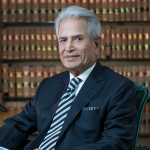 A K Mylsamy is the Founder, Managing Partner and the anchor of the firm. He holds a Degree in law and a Degree in Literature. He is enrolled with the Bar Council of Tamil Nadu.
 Mr. K Rajendran is a former Indian Revenue Service (IRS) officer with a distinguished service of 35 years in the Indirect Taxation Department with rich experience and expertise in the fields of Customs, Central Excise, Service Tax and GST. He possesses Master’s Degree in English literature. Prior to joining the Department, he served for the All India Radio, Coimbatore for a period of about 4 years.
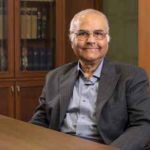 An MBA from the Indian Institute of Management, Calcutta, and an M.Sc. in Tourism Management from the Scottish Hotel School, UK, Ashok Anantram was one fo the earliest IIM graduates to enter the Indian hospitality industry. He joined India Tourism Development Corporation (ITDC) in 1970 and after a brief stint proceeded to the UK on a scholarship. On his return to India, he joined ITC Hotels Limited in 1975. Over the 30 years in this Organisation, he held senior leadership positions in Sales & Marketing and was its Vice President – Sales & Marketing. He was closely involved in decision making at the corporate level and saw the chain grow from a single hotel in 1975 to a very large multi-brand professional hospitality group.
 Mani holds a Bachelor Degree in Science and P.G. Diploma in Journalism and Public Relations. He has a rich and varied experience of over 4 decades in Banking, Finance, Hospitality and freelance Journalism. He began his career with Andhra Bank and had the benefit of several training programs in Banking.
 Mr. Kailash Chandra Kala joined the Department of Revenue, Ministry of Finance as ‘Customs Appraiser’ at Mumbai in the year 1993.
 S Ramanujam, is a Chartered Accountant with over 40 years of experience and specialization in areas of Corporate Tax, Mergers or Demergers, Restructuring and Acquisitions. He worked as the Executive Vice-President, Group Taxation of the UB Group, Bangalore.
 K K Balu holds a degree in B.A and B.L and is a Corporate Lawyer having over 50 years of Legal, Teaching and Judicial experience.
 Justice M. Jaichandren hails from an illustrious family of lawyers, academics and politicians. Justice Jaichandren majored in criminology and then qualified as a lawyer by securing a gold medal. He successfully practiced in the Madras High Court and appeared in several civil, criminal, consumer, labour, administrative and debt recovery tribunals. He held office as an Advocate for the Government (Writs Side) in Chennai and was on the panel of several government organizations as senior counsel. His true passion lay in practicing Constitutional laws with focus on writs in the Madras High Court. He was appointed Judge, High Court of Madras in December 2005 and retired in February 2017.
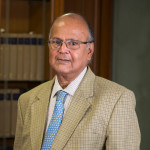 S Balasubramanian is a Commerce and Law Graduate. He is a member of the Delhi Bar Council, an associate Member of the Institute of Chartered Accountants of India, the Institute of Company Secretaries of India and Management Accountants of India.